Showing posts with label theory. Show all posts

Monday, February 21, 2011

Silence and noise

I haven't been posting lately because a) I'm stupid busy and b) there's so much happening so fast that I can't keep up with it the way I'd like, and I refuse to just bullshit.

That being said, I thought I'd throw up a tidbit from Abu Muqawama that is one of the only thoughts on the role of communication technologies in the overthrow of Mubarak that I actually find interesting and unexpected:

Both sides of the debate, a friend told me last night, are essentially correct: yes, the Internet, Facebook and Twitter played a terribly important role in mobilizing the Egyptians who filled the streets of Egypt to protest the regime. But yes, too, it took ACTUAL BODIES out there in the streets and not "Facebook Revolutionaries" just re-tweeting the struggle from the comfort of their homes. One interesting piece of analysis I have now heard from several smart observers is that by shutting down the Internet and the cellular phone networks, the Egyptian regime actually *increased* the number of Egyptians on the streets protesting. Not only did shutting down the Internet force people to leave the house and physically connect with their fellow protesters, but one friend noted that if you really want to piss off all of Egypt, a good way to do so is by shutting off cell phone service. More than Facebook or Twitter, cellular phone service unites Egyptians in a virtual community. And by shutting down cellular phone service, you're sure to anger Egyptians of all generations and classes -- and not just the college kids with Facebook accounts. So score one for the enduring power of 20th Century technology, perhaps.

Sunday, December 6, 2009

World wide web not looking so fun now

This new Iranian development is stunning:

The regime has been cracking down hard at home. And now, a Wall Street Journal investigation shows, it is extending that crackdown to Iranians abroad as well.

In recent months, Iran has been conducting a campaign of harassing and intimidating members of its diaspora world-wide -- not just prominent dissidents -- who criticize the regime, according to former Iranian lawmakers and former members of Iran's elite security force, the Revolutionary Guard, with knowledge of the program.

Part of the effort involves tracking the Facebook, Twitter and YouTube activity of Iranians around the world, and identifying them at opposition protests abroad, these people say.

Interviews with roughly 90 ordinary Iranians abroad -- college students, housewives, doctors, lawyers, businesspeople -- in New York, London, Dubai, Sweden, Los Angeles and other places indicate that people who criticize Iran's regime online or in public demonstrations are facing threats intended to silence them.

For example:

His first impulse was to dismiss the ominous email as a prank, says a young Iranian-American named Koosha. It warned the 29-year-old engineering student that his relatives in Tehran would be harmed if he didn't stop criticizing Iran on Facebook.

Two days later, his mom called. Security agents had arrested his father in his home in Tehran and threatened him by saying his son could no longer safely return to Iran.

"When they arrested my father, I realized the email was no joke," said Koosha, who asked that his full name not be used.

First of all, that's just scary. That is 1984 gone global.

It's also interesting, for two reasons. One is the way it actually works. It used to be that if a terrifying totalitarian regime wanted to reach outside its borders, it needed soldiers, spies, or double agents. Maybe satellites. The nice thing is that all of those things cost money--a fair amount of it--and good ones cost a lot of money.

Now, basically any regime with computers and a little know-how has a built-in web (no pun intended) of information and, it seems, even influence around the world. This has never happened on such a non-elite scale before.


Secondly, it's interesting in the context of the continuing process of reframing the idea of nations and territory that's been going on for the past couple of decades. Developments like multi-national corporations, the return of private military companies, and cyclical labor patterns that have people frequently moving between countries have done a lot to muddle the fairly fundamental (if never fully realized) notion of a one-to-one correspondence between state, territory, and nation (i.e. people, ethnic group, what have you).

Let's just say that this development does not make the situation any clearer. A few years ago it was in vogue to predict or announce the impending obsolescence of the nation-state. We were all going to be metropolitan now, or local, or global, or, well, something else.

That has not happened, and it doesn't seem likely. Rather, the nation-state is simply undergoing a process of repurposing and reformation. Where that will lead is hard to say in terms of the nation state; I'm confident that we'll see the sphere of global governance, mostly empty since the end of the Cold War (the U.S. all by itself does not count. It has influence over its allies. The Cold War presented an imperative and a set of incentives that came much closer to in some sense governing the whole world via arbitration by each side) begin to be filled in, whether by some other set of superpowers (unlikely, IMO) or by a true set of global institutions (also unlikely), or by something I haven't thought of (quite likely).

If and when that happens, I'm pretty sure this sort of behavior by any nation-state government will be unacceptable. Hopefully. Yeah.

Sunday, November 22, 2009

What I'm doing with myself

Today (yesterday) I had to write and send in a 6-page (double-spaced) statement about what my B.A. thesis will be. I was pretty happy with it and figured it wouldn't hurt to post it here. So without further ado:


I intend to examine Hamas and Hizballah from a perspective much different from that prevailing in political and journalistic discussions of these organizations. It is my view that the existing literature on political organizations does not account for the particular forms of power and violent tactics practiced by Hamas and Hizbollah. While these two are probably not the only organizations to employ such practices, my intention is to begin to build a framework for understanding their particular roles, capabilities, and structures as political organizations that could be applied more broadly to other cases.

I will show that Hamas and Hizballah are an unusual type of political organization, which I will term parallel or alternative government. Both Lebanon and the Palestinian Territories have been in the process of building a strong, democratic state for decades, but both have been hamstrung by a lack of agreement among their respective populations on questions that are fundamental to the statebuilding project. They have consequently been unable to build the robust institutions that would begin to constitute a state. In Lebanon, the question of a quota system in government institutions—whether one should exist, and whether the existing one is correct, just, and so on—is still contested; the current system has weakened the government to the point of paralysis, while the disagreement still existing over this structure has sapped the government’s authority and legitimacy. In the Palestinian Territories, the population is riven over the proper methods of “resistance” to Israel; the existing Palestinian institutions were created in negotiations with Israel and as such are inherently illegitimate to those Palestinians who reject negotiation and rather favor violent resistance. In both cases, the government structure represents a “side” of this fundamental question and so is inherently politicized, illegitimate to a significant segment of its population. Rather than serving as the location of policy, institutions themselves are policy. Finally, structural factors in the military, economic, and international political spheres have served to further weaken these regimes’ abilities to project power, deliver services, and command loyalty.

This weakness and the political divisions at its root have created a political space in both polities for a second, parallel government to spring up with the support of those factions which are in opposition to the “side” represented by the existing political structure. These parallel governments perform many functions of a governing institution: service delivery, security, national defense (as perceived by their supporters), and political representation. They are parallel rather than rival in that they do not seek simply to control the institutions of the existing regime, nor do they attempt to create a separate state; rather, they build their own institutions to further their preferred outcomes while remaining committed to a united Lebanon or a free Palestine. Rather than attempting to secure the reforms and policy shifts they want within a system that is too weak and dysfunctional to produce the desired outcomes, these constituencies have chosen simply to build the state they want.

Hamas’ and Hizballah’s use of violence has been one of the primary factors agitating the international discourse about them. I will examine the particular ways in which these groups deploy violence—when they use it, when they do not, against whom and employing what techniques—in order to show that their violent methods also distinguish them from most other political organizations. They are neither states, nor insurgents, nor guerrillas, nor decentralized terrorist networks; and they do not use violence in the same way as any of these. I will attempt to link their unique employment of violence to their status as parallel governments and to elucidate the relationship, if any, between their particular forms of violence and their particular forms of political power.

Both Hamas and Hizballah have used a variety of violent tactics, borrowing methods from a variety of forms of political organization. Hamas, in particular, has taken on statelike functions in terms of controlling violence. The group has done more to secure Gaza than the PA had ever accomplished: it integrated its police forces into the Gazan security forces (Crisis Group 2006: 9), secured the interior of Gaza against clan warfare for the first time, and made a credible attempt at controlling the inflow of weapons through the tunnels to Egypt (Crisis Group 8) as well as their display and sale within Gaza (Crisis Group 2003: 10). The Qassam Brigades were converted into an external security force and set to patrolling Gaza’s borders—a strong statement in the context of their longstanding domination by Israeli forces. Hamas also did its best to coordinate and control military resistance to Israel for the first time (Crisis Group 2003: 8), though this effort was not fully successful.

At the same time, Hamas has continued to use violence against Israel in ways that do not reflect the behavior of a state; rather than deploying an army, invading, or attacking Israel’s military capabilities, Hamas has continued to fire rockets into Israel, a tactic widely described as terrorist since the rockets largely impact civilian life. However, rather than mounting spectacular exhibitions of violence connected to high civilian deathcounts in connection with specific demands, Hamas has more often used its rockets as a reminder of its continued presence and resistance: the rockets are often aimed to avoid harming anyone, and do not have the sophisticated technology that would allow them to target specific Israeli buildings, persons, or resources. Hamas’s rocket fire is curiously ambivalent: it constitutes neither full-on war nor straightforward terrorism. Rather, it is a legitimacy-seeking exercise: Hamas is simultaneously able to demonstrate its commitment to the cause by being seen to be doing something and to declare its existence, defiance, and relevance to Israel and to the international community. Through rocket fire, Hamas carries out its mission of resistance and refuses to allow itself—and by extension Palestine—to be forgotten.

Hizballah, meanwhile, emerged from “a loose coalition” of Shi‘a groups who were radicalized by U.S. and Israeli interference in the Lebanese civil war (GlobalSecurity.orgb 2008), and originally most resembled a militia, drawing its soldiers from ordinary people in villages as needed. Its first major accomplishment was Israel’s ignominious withdrawal from southern Lebanon, and the group employed classic insurgency tactics in this struggle. Hizballah sought to secure the IDF’s complete withdrawal from Lebanon, including the Security Zone, and made its point with missiles, attacks, and suicide bombings. Their efforts lasted up through the 1990s, when the civil war officially ended (Morris 2001: 558), and have continued sporadically since. Suicide bombing was not a common tactic at the time, and it proved to be a crucial innovation on Hizbollah’s part in terms of making its name as well has having a clear impact on American and Israeli forces in Lebanon.

But Hizballah, too, has taken on statelike military functions. The Lebanese Army disintegrated more than once under internal and external pressures during the civil war, and Hizballah’s military wing was far more effective, disciplined, and cohesive. Its military no longer consists of The group has, essentially, taken on the task of national defense and border security against Israel, without regard for the policies of the official Lebanese government but with the approval of its constituency (primarily, but not exclusively, Shi’a in the south of Lebanon). Hizballah de facto rules several areas of Lebanon, including the northeast and, of course, the South, and one is more likely to find a Hizballah member or supporter than a government policeman in these areas.

These are a few of the variety of tactics Hamas and Hizballah have adopted as part of their repertoire of violence. While their individual practices or campaigns can be described using existing terms—insurgency, state-within-a-state, terrorism—the combination of them all within single, coherent organizations has so far gone unnamed in political science literature, just as the political function of these groups remains undescribed. What remains to be seen is whether there is a connection between the groups’ idiosyncratic uses of violence and their anomalous political status. How do Hamas and Hizballah view themselves as acting? What effect do these views have on Hamas’s and Hizballah’s parallel statebuilding projects, and on their countries’ statebuilding projects more generally?

Both Hamas and Hizballah not only practice violence but have constructed strong ideological links between their exercise of violence and their political identity. Hizballah has declared, “our military apparatus is not separate from our overall social fabric. Each of us is a fighting soldier” (Hizballah 1988: 1). Hamas’s mission is connected to violence at the most basic level: it exists for the purpose of violent resistance to Israel. In parallel with Hizballah, it argues that “It is necessary to instill the spirit of Jihad in the heart of the nation so that they would confront [sic] the enemies and join the ranks of the fighters” (Covenant: Article 15). Furthermore, both have asserted their independence from their supposed governments through maintaining their violent practices and capabilities against these regimes’ wishes. Alone of all the militias that sprang up in the civil war, Hizballah has refused the state’s injunction to disarm; it has also resisted political pressure to integrate its military wing into the Lebanese national army (Jamail 2006). Prior to its electoral victory in Gaza, Hamas maintained the operations of its military forces (Boudreaux 2007; Crisis Group 2008: 6) despite the orders of the Palestinian Authority and later took over government of Gaza through a violent coup.

These facts are suggestive of several links. The first, and simplest, is between the groups’ violent tactics and their political constituency: after all, their basic mission is violent resistance to Israeli dominance and to Western interference. Second, they seem to understand themselves and their operations—including nonviolent undertakings—in terms of war, as shown by their rhetoric. Even a worker in a Hizballah-run hospital is in some sense a soldier, just as a Hamas member who guards the tunnels through which necessary goods are smuggled from Egypt correctly understands himself to be committing an act of war against Israel. The role of religion and religious history in this understanding is important and bears further exploration, not only in terms of teachings regarding jihad but also because another aspect in which the groups are metaphorically fighting is for particular practices of Islamic life in their respective territories.

Third, violence and control of violence has been used by both groups in constructing their parallel governments, often directly in opposition to the regimes that ostensibly rule (or ruled) Gaza and Lebanon. One of the basic definitions of a state is a political entity that monopolizes violence within a bounded territory; by exercising and controlling violence, Hamas and Hizballah have concretely removed territory from the states in which they live and constructed separate zones of domination—yet they have managed to do so without seceding or attempting to partition the territory in question. Through a delicate balance of both internally and externally directed violence, service delivery, construction of parallel institutions, and participation in existing political institutions, Hamas and Hizballah have successfully built their parallel states.

Tuesday, November 3, 2009

Thank goodness for footnotes

"Civil right is personal freedom; political right is a right over others as well as oneself." --Alfred Fouillée, cited in Robert Michels' "Political Parties: A Sociological Study of the Oligarchical Tendencies of Modern Democracy."

Damn, apparently I need to read some Fouillée. This remark opens a lot of doors, potentially, particularly when you consider the struggles over "social issues" that tend to dominate contemporary American politics.

Sunday, June 14, 2009

Gender exists everywhere, remember?

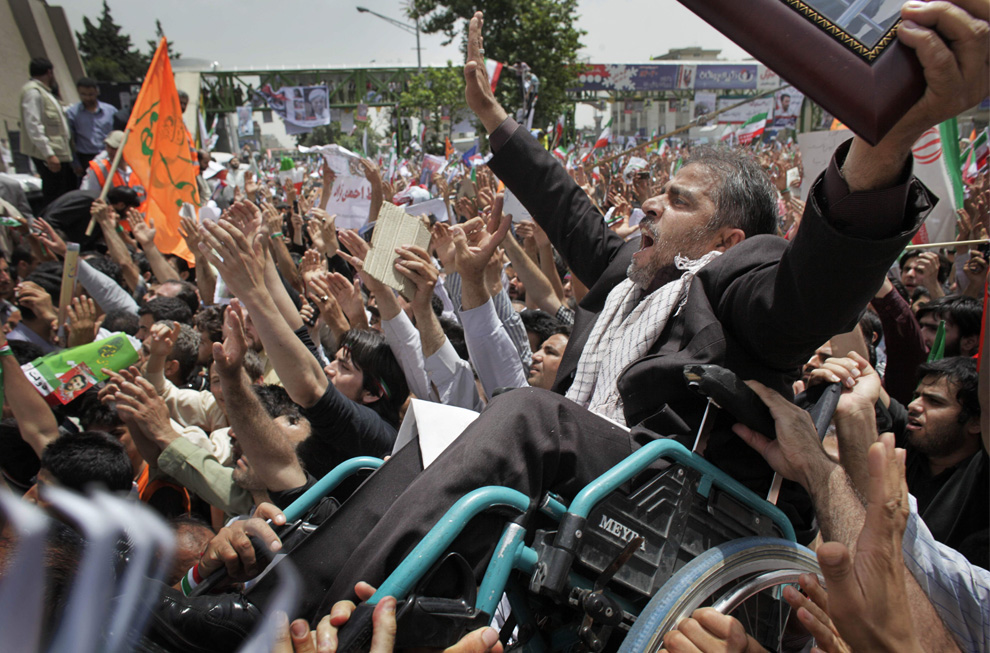
The Boston Globe has a gorgeous set of photographs (The Globe is always incredible for pictures) about the Iranian elections (pre-protests). This one really stood out to me:


A wheelchair-bound supporter of Iranian President Mahmoud Ahmadinejad is lifted above the crowd at his final election campaign rally, on Azadi street in western Tehran, Iran, Wednesday, June 10, 2009. (AP Photo/Ben Curtis)

I mean, wow.

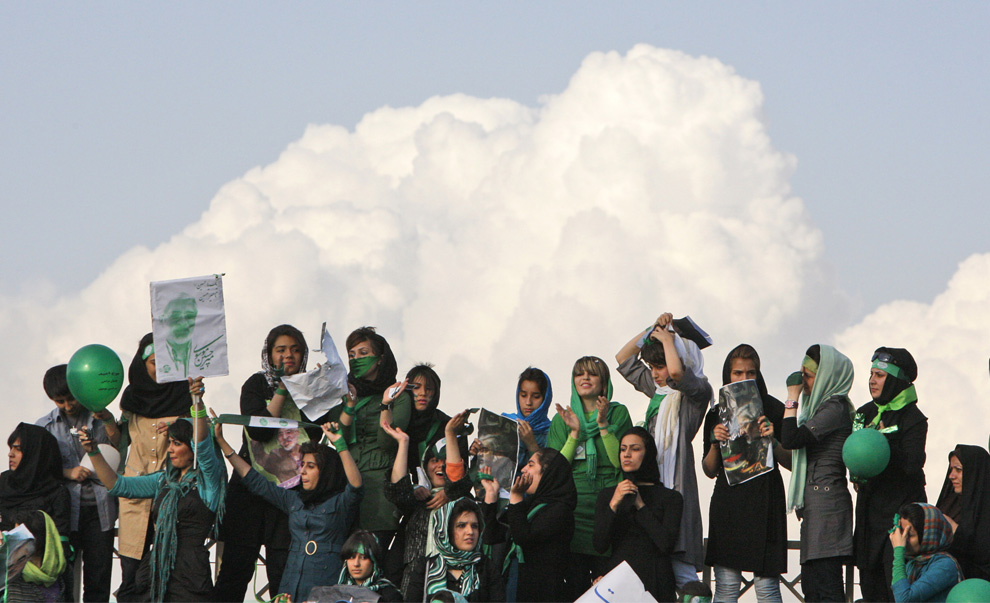
But something that struck me was the fact that several of the pictures of Mousavi supporters show crowds that are entirely or overwhelmingly composed of women. Look:


There are more. (Really, check the whole thing out, it's gorgeous.) Especially in the context of Anna's discussion of gender in the Lebanese elections at Feministing, I find this interesting. It may be that conservative women are simply less likely to attend rallies (where are all the male reformists, though? Are they not as pretty or something?) Anna:

I would like to think that the FPM’s nauseating “Sois Belle et Vote” (“Be beautiful and vote”) posters had something to do with [the opposition's loss].

[...]

Because of its sectarian political system (and corruption, and personality cults, and nepotism, and foreign interference, and its electoral law, and and and), Lebanese politics are at the extreme end of “unresponsive,” and very few politicians or parties boast nuanced, concrete platforms. But it’s one thing to not respond to female voters; it’s another to insult them.

This is in sharp contrast to what appears to be happening in Iran, if we are to believe NPR, the BBC, the WSJ, Reuters, The Times, and a number of other news outlets who are focusing on the power of politicians’ wives and the preferences of women voters in tomorrow’s elections. People here in Lebanon whose political leanings tend away from the Hizballah/Aoun opposition often refer to Hizballah’s Iranian sponsorship and express fear that Lebanon’s free, liberated (read: tank tops, bikinis, bank loans available for plastic surgery) women will find themselves swathed in chadors should the other side ever claim a political victory.

In both countries, whatever they are wearing and whatever they look like, women are highly educated (in Iran they are majority of university students) and have brains of their own in perfect working order. The way these consecutive election campaigns were/are being conducted – with Lebanese politicians ignoring women’s demands in favor of appealing to their presumed vanity, and Iranian politicians at least making an effort to promise things like cabinet posts to women – says a lot more about how women are viewed as citizens than their dress codes.


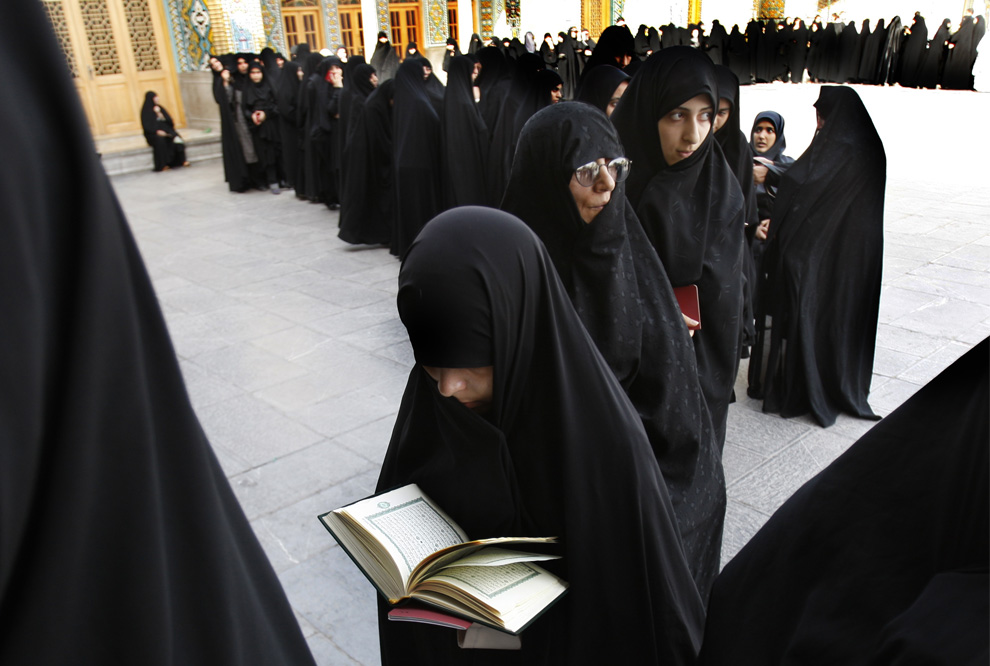
First of all, speaking of chadors, from the Globe again:

An Iranian women recites the holy Quran as she stands in line to cast her vote at the Masoumeh shrine in Qom, Iran on Friday, June 12, 2009. (AP Photo/Kamran Jebreili)

What an incredible image. I wonder why there are only women there; are polling stations gender-segregated? Do conservatives self-segregate? Just (unlikely) chance?

Regardless of the actual explanation, I'm quite sure it will never be explained or even examined by the Western press. I'm ashamed to admit that I had committed the pathetic fallacy that Anna implicitly pointed out of viewing Arab electoral politics only one way (in Lebanon by sect, in Iran by class/political orientation) and viewing Arab gender politics entirely separately. No one here is interested in the gender dynamics of these elections, because we're only concerned with the elections as they relate to us.

The dirty secret of Lebanese sectarianism is that it was revolutionized, fostered and empowered by the Western Great Powers (primarily Britain and France) starting in the mid-nineteenth century. (See Usama Makdisi's fabulous book The Culture of Sectarianism, which everyone should read before talking about Lebanon.) Various Western interests took religious communities as their own special protegés, partly as a way to get an economic foothold and partly as civilizing projects. The legacy of this dynamic is that we view shifts in the power distributions among various sects as signs of our own power and of the public's opinion of us. This is part of why we're so interested in Lebanese politics (that and all the civil war, and the wars with Israel).

Similarly, in Iran, we are not truly interested in the status of women--we occasionally make concerned noises, but usually it's a prop for a larger dislike of our regional enemy, a way of othering Iranians. I'm not saying women have it peachy keen; they don't. I'm saying that most American political concern for them is disingenuous, at best half-hearted. We're interested in elections and reformers for our own benefit.

And to an extent, that makes perfect sense: nations are self-interested. But the downfall of that view is that it really limits our ability to analyze events like these because we only have one lens. It didn't occur to me to wonder what the gender breakdowns in either election were, or to consider gender as a factor. (And I don't have a self-interest excuse: I'm a person, not a nation, and I study the Middle East.) Now that Anna--and these pictures--have forced me to think about it, it makes lots of sense that young women would be inclined toward the reformers' camp. They're educated, they have few prospects (Iran has a very educated and very unemployed population), and they want more options than Iranian women have had since 1979.

Ultimately, I don't have a lot to say about women in Iran, because I don't know much. I try not to speculate too much about subjects close to my specialty--coming out a doofus close to home is much worse than considering subjects that aren't important to me. But I'm glad that this blind spot has become visible to me. Now I can fix it.

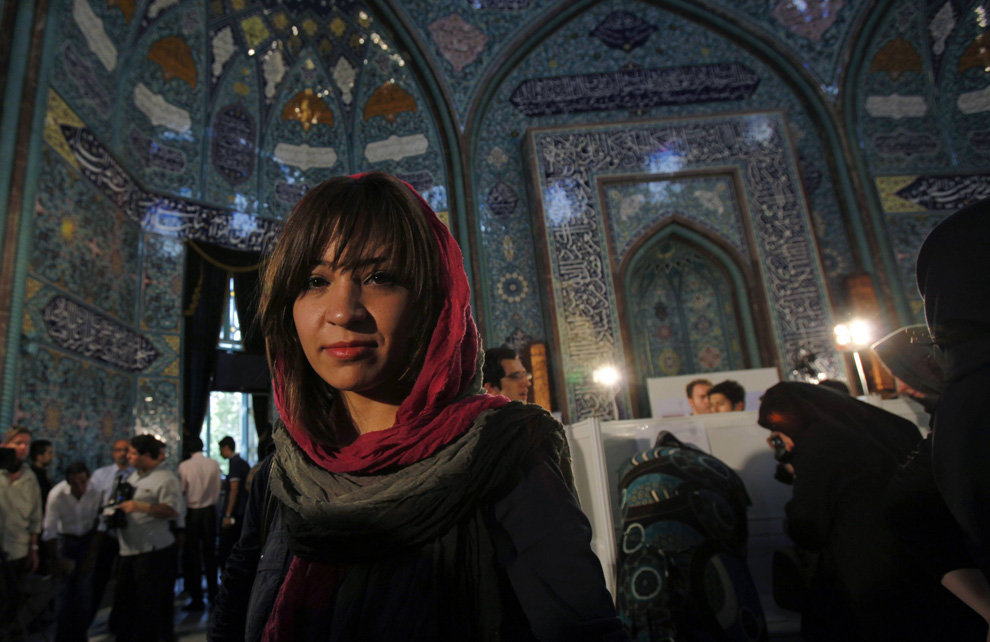
In closing, may I say that Iran is walloping us when it comes to attractive polling places.

An woman arrives at a polling station during the Iranian presidential election in Tehran June 12, 2009. (REUTERS/Ahmed Jadallah)

Saturday, June 13, 2009

God is great

Never in my life did I think I would see Andrew Sullivan write Allahu Akbar.

Snark aside, the post itself is a good thought (if delivered in typically epic language), and one I had as well--see the title of my previous one. Twitter and other new media have been essential to the opposition in Iran and to the publication of their efforts. Sullivan's comment that "you cannot stop people any longer" because they can get around the roadblocks with such technologies reminded me, oddly enough, of Russian History class back in high school. We discussed the roles of new transportation and communication technologies in making the October revolution possible.

I wonder if most revolutions depend on some kind of similar communication or transportation asymmetry. The 1979 Iranian Revolution was hugely dependent on cassette tapes: these were used to illicitly distribute Khameini's sermons to the public. The moment of triumph was the moment that the revolutionaries got control of the state television station and broadcast Khameini's arrival in Tehran, something the Shah had blacked out.

I mean actual revolutions, mind you, not coups: for a good coup all you need is some well-placed friends, an authoritarian system, and a little luck. Communications hardly matter. In actual revolutions, though, people need to be able to talk to each other. They need to feel that they're not alone, they need to plan and organize. Whoever's in power will always try to stop this, and usually an authoritarian state is pretty good at that. So most of the time, you need an asymmetry for this to happen at all, no? You need places where the government can't reach. Like illegal cassete tapes, or Twitter, or tunnels.

Wednesday, June 3, 2009

Targets

Ezra Klein reports that a consensus goal for healthcare reform seems to be emerging: "to slow the annual growth rate of spending by 1.5 percentage points." There's lots of very Reassuring and Serious chatter about how 1.5 percentage points may sound small, but it's going to be very difficult to achieve and would represent a great accomplishment.

Ezra is generous, to my mind:

What you can say about an annual slowdown of 1.5 percentage points is that it would be a magnificent achievement given the political difficulties of health reform, but it's quite a bit lower than could be achieved absent those constraints. [...] But though it's true that this new definition of success is ambitious given what we're likely to achieve amid a broken political system and a powerful health-care industry, it's probably quite modest given what could be achieved in more straightforward circumstances. And that's worth keeping in mind.

The kicker, though, is that 1.5 percentage points happens to be exactly the goal that the healthcare industry voluntarily offered for itself.

This puts me very much in mind of Susan Greenhalgh's Just One Child, which examines the conception, development, and implementation of China's one-child policy from the framework of an anthropology of policymaking. It's a fascinating read and I highly recommend it. In it, she notes that a particular goal--constraining the population at 1.1 billion--was arrived at by a particular set of policymakers based on computer models designed for missile control that were not equipped to consider concerns that social scientists would have thought paramount: demographics, the varying economic needs of rural vs. urban families, etc. This goal, enshrined in a highly technical report that won definitive status almost immediately due to very impressive and impenetrable math, political connections, and the privileging of "hard" science over social science under Mao, quickly became the unquestioned aim of population control policy in the Deng government, despite protest from social scientists that the goal was too ambitious and would harm rural families as well as women. (1.1 billion advocates retorted that it was better to aim too high, in case of falling short.) The result was the often punishing policy we know today.

I should hope the analogy is fairly obvious. In both cases a numerical policy goal was nominated based not on the most rigorous, inclusive, and pragmatic analysis possible, but rather based on other considerations and due to disproportionate political influence. It seems the target of 1.5 percentage points is well on its way to becoming an authorless, Reasonable number that everyone will endorse. The healthcare industry will be pleased, healthcare reformers farther from the centers of power--but often with better information about the effects of policy on the ground--will protest to little avail, and soon we shall have the healthcare policy that became inevitable when this number became The Number.

Policymaking is tricky business, and it has a tendency to turn into a sort of Rube Goldberg Machine (see below) where the final effect seems to have almost nothing to do with the original force even though the chain of cause and effect is there; it's just wended its way through a dizzying array of objects, people, offices, departments, obstacles and pathways.


Best Rube Goldberg Ever - Watch more Funny Videos

The final policy outcome of lowering costs by 1.5 percentage points (assuming policy is effective) will probably seem to have nothing to do with the industry by the time it is realized, or if it does this will be only because they, as Knowledgeable Businessmen with Experience, were wise.

However, that the number came from the healthcare industry is, as Ezra says, worth remembering.

Update: Also see DDay on the way healthcare can die.

Monday, June 1, 2009

Some beautiful posts

Go. Read them in their entirety. To excerpt them would be to mangle their integrity.

Hilzoy on Dr. George Tiller

One of Sullivan's readers on torture.

Sunday, May 3, 2009

Vigilantism in our politics, or: Mr. Smith suiting up?

It appears that ordinary citizens are declaring themselves superheroes--you know, masked vigilantes, citizen crimefighters, protectors of the innocent--in several American cities. Highest-profile is Shadow Hare from Cincinnati.

The linked article makes lots of fun of everyone involved, and I understand perfectly well why (not to mention it's from the UK Daily Mail). But I can't bring myself to just laugh outright. Maybe I've spent too much time with alternative comic books that investigate what superheroes signify, and with novels about comic books and superheroes, to take them unseriously. I've read far more in the metaliterature about superheroes (Watchmen, Kavalier & Clay, even Sandman to a degree) than I ever have in the actual superhero canon, and so when I think superheroes I really don't think flat (yet muscular!) characters in silly suits with unlikely adversaries and bad onomatopoeia for sound effects. I immediately think about mythology, cultural signifiers, narratives of good and evil, and perceptions of "the times we live in."

Along with that goes a certain affection for the notion of people who just decide "screw it, I'm dressing up and going out there." I'm not saying that such people, fictional or otherwise, are the sanest or best-adjusted; nor am I saying there is nothing laughable about them. But they do mean well in a much purer and easier sense, I think, than many other people who otherwise are similar. (Certainly they do in fictional cases.)

At any rate, via the video in the article it seems many of these people hang out at The World Superhero Registry, which has some rather forbidding language on its front page:

This website deals with the actual incorporation of the superhero archetype into daily life. As a consequence of the complex and ever-changing nature of the legal system and the diverse and unusual activities that may be involved in such alternative lifestyles, some of the activities described herein may be in conflict with local laws in some areas. None of the creators of this web page specifically condone any of the described activities or the possession of any of the equipment related to those activities. We are not legal experts and lack the expertise and resources to research the legality of any of the practices of our members, or visitors.

This does make one worry for their good intentions. (This is, of course, one of the eternal superhero dilemmas: don't we have laws for a reason? How can you be sure that your forces for good, once unleashed, will stay good? And what if there are disagreements about the good? But I digress.) I have no idea whether my reproducing content from the website would count as the sort of thing for which they require permission, as I am not a member of the press, but I'll avoid direct quotes.

I am fascinated by the Registry. There are three immediate requirements: costume (signifies dedication), heroic deeds (above and beyond your average concerned citizen), and motivation (personal, uncompensated, and spontaneous). The website has things you'd probably consider essential: tutorials, a forum, a map of superheroes around the world, and a place to request assistance. But there are also book and movie reviews, a photo gallery of self-made "gadgets", a support forum, a press kit, and a philosophy section. It is, in short, an online community not unlike special-interest websites that have been started before; it is actually eerily reminiscent of Glenn Beck's 9/12 project.

The similarity is no accident: I think there are some broad connections to be made between our politics and superhero fetishism and/or vigilantism (the two overlap but are not identical).

Firstly, I think the level of superhero activity--real and imagined--in this country at a given time is probably rather analogous to "right track/wrong track" polling: the U.S. is in a bit of a ditch at the moment and people feel the need to do something about it. Happily, not everybody expresses this impulse in the manner of Timothy McVeigh. Sure enough, the superhero map shows the highest concentration of superheroes in North America (by which I mean almost exclusively the U.S.), followed by South America, perhaps one guy in Finland, and a few in the UK. (Some of these people are clearly funning, but shhh. Some of them definitely are not, particularly in the U.S.)

Superhero mythology lends itself particularly well to clear-cut battles between good and evil (or at least the desire for such in the face of more difficult troubles), and particularly in the case of the Batman/Gotham storyline can be seen to be reflective of a notion of a tide of societal evils, venality and disintegration battering at the weakening bastions of order, justice, and virtue. I find it interesting that as far as I can tell, The Registry's superheroes are not interested in fighting terror--they want to improve the lives of the people around them. They want to improve their neighborhoods and (of course) themselves. The struggle here is not abroad, not Us (whoever We are) against The World, but Us against Ourselves.


One of the other major tropes of superheroics is, of course, transformation. Whether there is a paramount transformative moment (Peter Parker being bitten by the spider; the creation of Dr. Manhattan) or an everyday transformation (Bruce Wayne into Batman), or even a more essential transformation through which one discovers one's true nature as a mutant (X-men) or an alien (Superman), at some point the hero crosses a line from ordinary citizen to extraordinary activist. We are currently in a moment of intense economic upheaval; more than that, we are undergoing a profound national political unmooring in terms of conventional policy wisdom as well as our national self-definition on some key issues (torture, a social safety net, gay marriage, legalized marijuana). The increasing chasm between conservatives' and their opponents' views of what is currently happening in this country and what it may mean illustrates how much we are in free fall. We have found ourselves at what feels like an inflection point, and it seems necessary to redefine or at least investigate what it means to be an American as well as what it means to be a citizen of a democracy that has gotten so big, so delocalized, and so distant from its government. I give you Jim Manzi:

Suppose we had a 9/11-level attack with 3,000 casualties per year every year. Each person reading this would face a probability of death from this source of about 0.001% each year. A Republic demands courage – not foolhardy and unsustainable “principle at all costs”, but reasoned courage – from its citizens. The American response should be to find some other solution to this problem if the casualty rate is unacceptable. To demand that the government “keep us safe” by doing things out of our sight that we have refused to do in much more serious situations so that we can avoid such a risk is weak and pathetic. It is the demand of spoiled children, or the cosseted residents of the imperial city. In the actual situation we face, to demand that our government waterboard detainees in dark cells is cowardice.

On its face, this passage is about waterboarding and about torture, but it is also very much about American notions of citizenship and representative government. Notice the distinction so easily and, it seems, unthinkingly drawn between a Republic, which makes demands on its citizens, and an imperial city (no capitalizations), which cossets its residents. In that contrast alone are notions of environment, borders, locality, global standing, and the relationship between a state and its constituents. These are the sorts of questions we are grappling with.

Many of the Registered Superheroes may have suffered their own economic dislocation. Some of them may be social conservatives who think the entire country is on the brink of sliding into the political, economic, and cultural sea. Some of them may be people who have been dissatisfied for a long time and have been hoped and changed and grassrootsed enough to try to go on and do something about it. Indeed, the relationship between ordinary and extraordinary persons and their ordinary and extraordinary acts is an essential one in American politics: activists try to convince people (in oddly Catholic fashion) that they, the ordinary, by good works can be transformed into the extraordinary, while politicians allow them a Protestant claim of grace newly discovered (did I mention that we are the ones we've been waiting for?). Watchmen vs. X-men, one might say. Similarly, American exceptionalism and certain forms of cultural nationalism on the right exult in the sheer ordinariness of certain tropes as signifiers of an exceptional nature--it is through ordinariness, and its inherent virtue, that we are transformed. Some of our most beloved political bedtime stories, such as Mr. Smith's much-vaunted trip to Washington, can be easily seen as a sort of whitewashed form of vigilantism in which everyone is a winner.

Despite all of this complicated hot air, some of these superheroes are definitely 11-year-old boys. Not everyone thinks in these terms, nor should they (if you think the economy is bad now, hoo boy do I have a doomsday scenario for you). But I do believe in zeitgeist and in discourses, and these currents are in the air.

What I want to know is, have phenomena like this arisen at every moment of national freefall? Is this happening now because a national movement like the Civil Rights movement or the anti-war movement of the 1960s and '70s is so deeply absent? Did this work remotely similarly before the internet, and if not, how essential is the reinforcing presence of colleagues in crimefighting? How analogous is this to other, more sinister forms of vigilantism? How does it relate to acts of domestic terrorism like the uber-conservative attacks on liberal churches and groups we saw a few months ago? Are these different responses to the same broad stimuli (with different triggers, clearly)? Is the difference in degree, kind, or both? What's the explanation for the apparent concentration of registered avengers in the eastern half of the country (in an unexpected twist, they are evenly distributed between North and South)? Finally, I think this could make a brilliant case study for some of the conservative critiques of the delocalizing, isolating, and concentrating effects of communications technology on culture (such as can be found at Front Porch Republic). What can I say, I love giving out free tips.

On a less political note (I can't help myself): I'm fascinated that the press's gentle mocking of these gentlefolk seems to center around their lack of physical impressiveness. I don't think even those commenting on the superheroes realize that their criticisms are precisely based in the superhero mythology they find so ludicrous. One would think that in this age of technological advancement we would find it less necessary to have someone's moral strength be so concretely represented in his or her physicality, but I suppose our culture is still plenty body-obsessed--perhaps particularly at a moment of disorientation and dislocation. (Plus, they don't quite have the gadget gallery up to Stephen Hawking's level.)

Wednesday, April 29, 2009

It's that time again

Link dump!

First off, Marc Ambinder brings us this graphic from Pew on party ID:


I think this is great news. The two-party system is moribund and the lesser its hold on the voting population, the better.

Next: Kevin Drum meditates on torture. An excerpt:

The whole point of civilization is as much moral advancement as it is physical and technological advancement. But that moral progress comes slowly and very, very tenuously. In the United States alone, it took centuries to decide that slavery was evil, that children shouldn't be allowed to work 12-hour days on power looms, and that police shouldn't be allowed to beat confessions out of suspects.

On other things there's no consensus yet. Like it or not, we still make war, and so does the rest of the world. But at least until recently, there was a consensus that torture is wrong. Full stop. It was the practice of tyrants and barbarians. But like all moral progress, the consensus on torture is tenuous, and the only way to hold on to it — the only way to expand it — is by insisting absolutely and without exception that we not allow ourselves to backslide. Human nature being what it is — savage, vengeful, and tribal — the temptations are just too great. Small exceptions will inevitably grow into big ones, big ones into routine ones, and the progress of centuries is undone in an eyeblink.

Whether the point of civilization really is as much moral advancement as physical (what does that mean, concretely?) and technological advancement is, if you ask me, up for debate. But the liberal political project (and I mean liberal not in the American political sense but in the philosophical sense that includes both Rousseau and Burke) certainly argues that it is. Without that presumption the entire structure of liberalism is undone. The American democratic structure is deeply predicated on that framework, and so while I think from a realistic, anthropological, and even historical viewpoint Drum's assertion may be questionable, I think it's useful in terms of this discussion.

Finally: I've been a bit curious about John Huntsman, Governor of Utah, since he revealed that he supports civil unions--who wouldn't be? Utah is about as solidly red as a state can get, and that redness is very cultural. He himself is a Mormon. Finally, as it's starting to seem that he'll run for President, I got myself over to his Wikipedia page and I must say the man holds my interest. I think he falls under that category of politicians whom I like and respect and want to see do well--but not so well that I'd vote for them. I have the feeling that I'm diametrically opposed to Huntsman on most fiscal and economic policy, but I respect the independent thinking (or, potentially, political brilliance) that his social heterodoxy would seem to represent.

It's midterms week here, and I've had two tests, two papers, a B.A. thesis proposal, and the nervewracking act of asking an important professor to be my thesis advisor to handle--and it's only Wednesday night!--so that's all I got. Time now for my brain to be allowed to shut off.

Wednesday, April 15, 2009

Things fantastic

Ron Paul seems to be advocating privateering as a solution for Somali pirates [h/t TalkLeft]:

Rep. Ron Paul (R-Texas) and a growing number of national security experts are calling on Congress to consider using letters of marque and reprisal, a power written into the Constitution that allows the United States to hire private citizens to keep international waters safe.

Used heavily during the Revolution and the War of 1812, letters of marque serve as official warrants from the government, allowing privateers to seize or destroy enemies, their loot and their vessels in exchange for bounty money.

He is absolutely correct that this is a good idea if you want to have some sort of naval presence off Cape Horn for minimum cost. That this idea is being floated at all is fascinating to me given that we are living in an age of mercenary rebirth and proliferation; it seems everything old really is new again in the realm of privatized violence.

The trouble with privateers is that they date from a time when states weren't very powerful. They couldn't afford to police their own waters, so they allowed privateers (whose mission was not only to police but significantly to hand some booty over to the Crown) to operate more or less unrestricted. Privateers disappeared, just as mercenaries did, when states developed the power, capacities, and institutions to perform these functions themselves.

We have had states powerful enough for this for a long time. International law and custom has evolved based on a framework where states control and are responsible for the actions of their citizens, by and large. To willfully set a bunch of bloodthirsty Americans free somewhere across the world will not be well-received. Piracy is messy. It is unprofessional. There will be unpalatable deaths, probably rape, the wrong sort of plundering, etc. The U.S. will still be held accountable for such occurrences in a way that the French monarchs in the 16th century simple could not be. Furthermore, it is my opinion that resorting to piracy will make the U.S., whose superpower status is in many ways based on its military superiority--and I mean that conceptually, not historically--look weaker than if it had not gotten involved at all.

That such ideas are being floated may represent how much smaller Ron Paul wants the U.S. military and government to be. Or they may represent how strapped for cash and truly weakened they are. I actually find it bizarre that Paul, generally quite consistent when it comes to smaller government and military nonengagement, thinks we need do anything off of Cape Horn at all; there is no direct, let alone existential, threat to the U.S. Perhaps I'm missing something here, or maybe Ron Paul just really wants to be able to vote for a letter of Marque before he dies.


Meanwhile, Blago is trying to get on reality TV: "Ten celebrities will be dropped into the Costa Rican jungle 'to face challenges designed to test their skills in adapting to the wilderness,' a network statement said."

I admit it. If Blago is on it, I think I'd watch.

Monday, April 6, 2009

Newspapers and democracy

Newspapers have been linked before by theorists of democracy as practiced in nation-states (read: as developed in Western Europe and the U.S.) to healthy democratic practice, by informing the public and holding politicians accountable. Fourth Estate theory, one might call it.

There's a pushback meme going around right now that argues the contrary:

The dominant institutions of the press...actually work to keep reality from us, whether it's the truth of money in politics, the social costs of 'free trade,' growing inequality, the resegregation of our public schools, or the devastating onward march of environmental deregulation.

[Bill Moyers quoted by Jack Shafer at Slate]

Or, at least, that they're not as essential as we think they are.

I don't have a particularly strong opinion about newspapers' function as the fabled Fourth Estate, though I do generally feel that in all aspects they are probably less important than we think they are, and that institutionalized investigative journalism is less important for any ability to puncture the powerful than it is for simply collecting information we mightn't get otherwise--the Baghdad Bureau function is hard to fulfill with volunteerist citizen journalism, for example. That is, I don't think that information is as powerful as we like to think it is.

The reason I think it's not super-important for democracy is related to some concepts that came up in Lisa Wedeen's class last quarter. We tend to assume that the way democracy developed in W. Europe, alongside the emergence of the nation-state, is the only way. Newspapers have been fairly convincingly linked to nation-building by Benedict Anderson in his classic work Imagined Communities (though I'd love to see some statistical research on that similar to Collier's and Fearon's work on civil conflict onset); whether they, or some analog, are necessary is not obvious to me. However, democratic practice need not coincide with liberal values; see Wedeen's book Peripheral Visions for examples of their decoupling in Yemen, for example. Democracy does not necessarily require a strong bourgeois middle class, intense property values, a Fourth Estate, humanist notions of the equal value of every human being, etc. Not all democracy is liberal, and not every democracy is European-style. To me, this is the strongest theoretical argument for why newspapers are not so essential as we think they are. For a more pragmatic argument, Shafer's piece also makes some good points:

Even an excellent newspaper carries only a few articles each day that could honestly be said to nurture the democratic way. [...]

On those occasions that newspapers do produce the sort of work that the worshippers of democracy crave, only rarely does the population flex its democratic might. How else to explain the ongoing political corruption in Illinois, which its press has covered admirably? Maybe an academic at Champaign-Urbana can prove that newspaper investigations of political corruption "damage" democracy by increasing the public's cynicism. Or that stellar newspaper coverage that increases participation in the political process stymies democracy by recruiting too many knuckleheads. Or that bad (but well-meaning) journalism—of which there is too much—cripples the democratic impulse.

The insistence on coupling newspapering to democracy irritates me not just because it overstates the quality and urgency of most of the work done by newspapers but because it inflates the capacity of newspapers to make us better citizens, wiser voters, and more enlightened taxpayers.

Saturday, March 28, 2009

Meta

So James Poulos was the conservative with the mutton chops and the velvet jackets I wrote about with delight the other day. I stumbled across a post of his at The American Scene and ended up hopskipping through his archive there as the whimsy has taken me. I've been impressed numerous times, but this post took the cake for me: Ophelia, I'm Only Dancing: Lies, Damned Lies, and Metafiction.

This is the risk run in playing the dangerous game of constructing realities that are fictions and fictions that are realities. Kafka’s Sancho makes good on that risk because he has so tightly circumscribed his paradox: with Quixote and himself, he is constructing one single relationship. Adding layerings of metafiction, as Hamlet does, adds illusory escape hatches and fire exits. Kafka’s Sancho develops his metafiction so as to bring on a reckoning for which he hasn’t the courage. Hamlet develops his own so as to indefinitely postpone a reckoning which works its vengeance out on him anyway. Our contemporary play seeks to have it neither way — by lowering the stakes and multiplying the layers, we can, we hope, hop endlessly among shifting perspectives, never trapped in the responsibility that follows on performance in reality. But this move raises the stakes of the dangerous game. Becoming less conscious of the risk involved increases it. Suddenly becoming conscious of it, under the pressure of both believing and unbelieving, may trigger a shattering disillusionment — and a disgust for all fictions.


In many ways it's overly baroque and theoretical, but it's so unapologetic and, well, good, that I don't care. It's revelrous.

Friday, March 13, 2009

Good one

As you may know, Jon Stewart and Jim Cramer (of CNBC) have been engaged in a bit of a spat lately. A summary:


Well, last night the other night [ed.: this post took a few days] Cramer went on Stewart's show, the poor fool. All I can really say is oof. Tim F. at Balloon Juice said, "My immediate reaction is that the whole experience is painful to watch. It would be great if someone could explain to me why Jim Cramer did not stay home."

He received numerous responses, as is the norm at BJ, but I somehow was struck by these two:

Just Some Fuckhead

We are in freefall as a society when a fucking comedy channel is the only place we can get hard news.

Indylib

@r€nato:

Why is it that two comedians on basic cable are pulling so much of the weight for our so-called journalists?


The comedians do good journalism and the journalists do really, really, really bad comedy.

What really did it, honestly, was one commenter's link to "his take on the exchange, in comic book pictures." The first picture is from Watchmen, and the post is called "Don't Fuck with the Comedian."

Also relevant here is the honestly incredible comment thread over on Roger Ebert's blog post on Watchmen. (If you want to get some really nice basic education in quantum physics, scroll until you see some long comments and hunker down.) There I read, among other things, the following:

Ross Durham: ...between your review and this blog entry there is little mention of my favorite aspects of the novel. What about the Comedian? What about the joke? It's a very postmodern look at the human condition in addition to being a look at humanity, or life's, place in the universe.

alex: ...you do have to realize that the Comedian is living his life as being one great big parody of Humanity and his actions just really go to show what he thinks of humanity.

Ike: the Comedian, the nihilistic everyman, who wonders why god will not save him from his own immorality, and finds the entire situation to be one giant joke.

Emphasis added to this one:
Ray R.: While Manhattan is interesting, the real depth in the story is The Comedian. "The Big Joke" is what this is really all about. While nuclear war and the atomic clock are significant symbols, the most prominent and repeated motif is The Comedian's smilely face marred with blood. It's present at the beginning of the story and at the end of the story. Even as Dr. Manhattan stands on Mars giving his huge and empty speach about the uniqueness of each individual (come on dudes - anyone who knows the first thing about science knows what a load of junk this speech is), the camera backs up and reveals that his beautiful construct is actually a small portion of that big smiley face. Manhattan is interesting, but The Comedian is the real key to understanding Alan Moore's masterpiece.

All of this initially had the effect of making me go looking for my copy of Watchmen to reread it so I could get a handle on the various inklings stirring around my head. Unfortunately, I can't find it (though the search has led me to a desire to reread A Canticle For Liebowitz also, as it shares a certain nihilist cackle).

So instead of that, head back over to the Balloon Juice comments for a minute (bear with me):

jwb:
@William

The irony of Stewart and other Hollywood celebrity commentators like Maher is that they are really the only people in the country who have both regular, guaranteed access to the media and the willingness to point out the bullshit. They’re famous and wealthy enough not to be overawed or intimidated by politicians and executives and too prominent to be suddenly "disappeared" from the TV screen by the media for being too honest.

Actually, it’s their humor that gives them the power—not their celebrity or wealth (in the league they are playing in, that’s miniscule). That’s their difference from someone like Cramer—who has to depend on shilling for da boss guys because he can’t bring in the eyeballs any other way.

And now back to Ebertville:
Daniel: The tragedy of this movie is that it could translate only in severely truncated form what I think is the most interesting part of it and what you rightfully put in the title of this blog entry: the bit about being a puppet that can see the strings.

...We are, as a species, only starting to see the strings. Our growing knowledge of the universe creates entirely new intellectual challenges to deal with. H.P. Lovecraft wrote: "The sciences, each straining in its own direction, have hitherto harmed us little; but some day the piecing together of dissociated knowledge will open up such terrifying vistas of reality, and of our frightful position therein, that we shall either go mad from the revelation or flee from the light into the peace and safety of a new dark age."

ABVC: If there is someone else controlling your deeds and your thoughts, he could choose in an arbitrary way what you were going to do. You would only see the strings if he wanted [you] to. But then, you wouldn't need a crazy experiment gone wrong to see them. Maybe if he wanted you to need it.

If there is no puppeteer, or the pupeteer [sic] is not someone with a will, but the universe, then the possibility arbitrariness (is quantum randomness arbitrary?) would be eliminated and we would be puppets of the laws of cause and effect. You have a will, but it is not free, it is the effect of lots of causes.

All of this pasticherie on my part is intended to be pointing at the way we think we understand The Economy and a little bit at journalism. I'm now going to back up, sort of, and go through my own thoughts, tying back to all this source material when appropriate. Again, bear with me.

Current discussions of economics and the economy contain a bizarre contradiction: On the one hand, the Free Market Rulz OK because the economy is too complex, diverse, and fast-moving to be comprehended sufficiently by any planner or regulator. It is, to a certain degree, unknowable and all-powerful, if benevolent. This idea is roughly analogous to ABVC's description of a puppeteer with no will--"the laws of cause and effect. You have a will, but it is not free, it is the effect of lots of causes." (Free-marketeers might object to the statement that the will is "not free," but I think that the distinction that might be made here is not actually very significant, at least for what I'm trying to do. The "effect of lots of causes" bit I think is unimpeachable.)

On the other hand, we flatter ourselves that with enough math, studies, models, and theorizations we can understand how these things work. Even with the whole question of government interference set aside, there is more than one industry entirely devoted to studying and understanding the workings of The Economy, whether that means finance, Depression economics, international development, day trading, or financial journalism. This effort is roughly analogous to the notion of "seeing the strings", or trying to.

We understand the economy as both a reflection and the driver of our entire world. "Stocks rallied today in response to _______"; "In response to the recession, people are rediscovering the value of ______ by _______"; "We may see a cultural shift through learning to deal with austerity"; and "culture of commodification" are only a very few of the thousands of phrases we use to describe what the economy does to us or how it reacts to things that we do. The story is, In the endlessly circular dance of incentives, choices, and effects, easy credit and a housing bubble caused "reckless" spending and lending, which sent the economy to recklessly dizzying heights, leading to a crash which, apparently, will now reshape our entire culture and bring us a new Greatest Generation (unless it simply ends the world as we know it). This is a bizarre combination of The Economy's being by and of us while simultaneously being completely alien to us. We do things to it, we figure it out and profit off it, we game it, we live in it, but occasionally it completely swamps us. It's a force of nature--it is to us as the sea is to fishermen, or the Euphrates was to Mesopotamian farmers (floods are a central mythic trope in ancient Mesopotamian religion).

It follows from this that we seek to understand how this incredibly powerful force works and what our place in it is--to "see the strings". Just as we try to understand and harness physics, we try to understand and harness economic forces (maybe this explains all those Wall Street physicists).

But the great irony is that all of our efforts to see the strings--our glass edifices on Mars--are ultimately recursive and meaningless. They fit together, they explain each other, and most of the time they fit reality well enough that they seem to explain and describe it. But every so often things happen that they did not predict and don't explain, or at least don't explain conclusively. Even the Great Depression is not understood, in that lots of people understand it in completely incompatible and mutually exclusive ways, and we've had a good 80 years to try to figure it out. (The "was it Keynesian stimulus/WWII, or just the natural end of the downturn?" debate reminds me of the quantum debate about nonlocality--there are strong arguments for both, and no proof of either, and no clear way to figure it out.) Ultimately, we don't see the strings at all; we argue endlessly about the workings of our little glass automaton and fail to understand that it's sitting in the middle of a massive smiley face.

Lately, I've been having a very difficult time caring at all about the news when it comes to the recession, banking system reform, bailouts, any of it. I'm sure part of it is just fatigue with the whole thing. But I keep finding myself retreating into what I've dubbed my anthropologist's cynicism, which is the belief that none of this actually matters at all and most of it isn't real. NOTE: this is not to say that the hardship involved isn't happening. Of course it is, and it matters. But sometimes it's hard to believe that what's happening isn't just some sort of spontaneous, natural sea change or cycle, like a tidal wave--that something very like it would have happened nowish almost no matter what we did, and that AIG and CDOs matter about as much as algae. This entire disaster is built on a near-incredible series of abstractions (going all the way back to currency--I won't go so far back as the notion of property), to the point where one can almost think of it as a mass hallucination. Furthermore, even when I come out of my academic funk enough to take the crisis at face value, the degree to which nobody has any idea what is going on or what is to be done about it, and the degree to which any one opinion can be convincingly argued against, certainly suggests that while the phenomena at hand are real, our understanding of them is merely a comforting fiction.

This idea is not at all surprising to the anthropological cynic. As I learned over and over in The Anthropology of Policymaking, policy frequently has myriad effects in addition to--or in place of--its intended result. The process by which problems are identified, solutions conceived, and policies implemented generally involves multiple heroic assumptions, sometimes retrospectively insane logic, willful ignorance and oversimplification. What policy or methods represent the best solutions is determined less by an empirical advance of knowledge than by personal politics and ideological fads--much as in economics (supply-side! No, demand-side!) and quantum physics (nonlocality is real! No, it's not! It secretly doesn't violate relativity, I swear! Except when it does!) But we persist in believing, very firmly, that policymaking and many other arguably more quantitative fields are rational processes of improvement, whose wildly unpredictable results are owed more to the complexity and difficulty of the problems or questions these disciplines engage than they are to the complete disconnect between what we think we are doing and what is actually going on.

This, of course, is the joke. We think we see the strings, but they are far too long for us to comprehend them as such. They may not actually be strings at all, but rather Slinkies--hell if I know. This is why (in colossally superior and self-satisfied terms) I'm so bored with the financial crisis stories: a joke isn't funny when you already know the punchline. The punchline is that we don't actually understand the economic forces around us, nor do we understand our interactions with them. It's all fooled by randomness with a healthy dose of storytelling and myth. A form of paganism, if you like--believing that human actions affect natural phenomena. (Thank god we burned a Yule log this year, or the sun might not have come up in January either.)

Much the same can be said about political journalism and even journalism as a whole. There were many astute comments about this in the BJ thread as well as in the original post; there was also a Marc Ambinder piece that I cannot for the life of me find that I thought said something very true about the election coverage. Ambinder said that he truly thought, and had for most of the election, that the whole thing would swing on voters really hating Republicans right now plus a couple of big, sort of constant issues (I think the war and maybe the economy). That was it. None of the daily stories mattered. But he, and the press in general, can't just write that one story and be done with it. Nor can they write the same damn story word for word over and over (much as it may seem like it sometimes). So they cover all the little stuff that doesn't matter as if it did, because it's a story. And people who follow politics, who follow campaigns--and people who are in campaigns--all come to believe that it matters too, because again, what are they going to do? Sit around, whistle, and wait for November?

I'm sure this same basic myth applies to many more human endeavors, especially as everything that humans do becomes more and more data-driven on a more and more granular level. We have to do something with all that data, and so we come to believe that it's important. We build whole occupations around collecting, analyzing, and storytelling that information (in a sense, that's part of what finance is, and it's certainly what financial infotainment like Cramer's show does). Only very rarely does something big enough and inescapable enough come along and show us that it's all one big joke.

In the margins, though, we have court jesters to point out how silly it all is. Humor rests, often, on uncomfortable truths--on saying things that are just true enough to laugh about but not so true as to kill the party that is our collective hallucination that we can see and even pull some of the strings. The reason journalists keep finding themselves in service to the big guys, as Glenn Greenwald points out in searing terms, is that the daily practice (as opposed to the occasional monumental achievement) of journalism involves maintaining those fictions, structures, assumptions, and logics. This isn't, particularly, an insult to journalism--it just means that journalists, like everyone else, live in a kind of social fiction. If they stepped outside it, not only would power structures make their lives difficult, but no one would actually understand what they were saying. They would look like crackpots. Humor is, most often, only language we have for such things.

In that sense, then, it's not so surprising that the key to Watchmen, or, on occasion, the real truth-teller in the room, is the comedian.

Sunday, March 1, 2009

An interesting snippet

For those of us interested in political rights and institutions, anyway. David Schraub discusses Jews' security in the U.S. over at Alas, A Blog.

There is a difference between a legal right and a legislative privilege, and it isn’t just that the former is more difficult to dislodge. I’ve already written about why I think rights are important beyond the technical protections they do and do not provide. There is considerable expressive power in being seen as a rights-holder. A person who is protected from unequal treatment merely because they currently hold the favor of the sovereign and her sword exists on a qualitatively different plane from the person whose protection stems from the fact that society — as per the strong moral norms expressed through the language of rights — considers such discrimination to be a grave normative wrong.

[...]

The fact that rights often are a formalist facade does not, to my mind, mean they always are, or that they are meaningless. I think that possessing rights is a powerful social signal of full inclusion into the community. A protection by right is one that is normalized, a protection by special legislation is exceptional. I would much prefer to be in a position where I am protected because it is seen as wrong to hurt me, than to be protected simply because those who wish to hurt me are (currently) in no position to do so. The cynics would tell you that the former case does not exist. I refuse to believe that is true.

Saturday, February 28, 2009

Death and taxes

If there's one thing I've come to accept, it's that other people simply don't agree with me about death and they never will. To me it is Just Not That Big a Deal. Obviously I don't want to die, but I don't believe in any sort of afterlife or reincarnation or continuation of the soul--I believe we rot, and that's it, and I'm really okay with that.

For some reason this notion freaks a lot of other people out, and as I said I've sort of learned that for whatever reason I just think differently about this than they do and that we are never ever going to agree. (I'm okay with that, by the way.) Furthermore, the basis of our various feelings on this isn't exactly super-empirical/logical, and so arguing and reasoning with each other will never bring us into agreement.

Again, that's okay. I bring it up only because I am increasingly starting to believe that the same is true over taxes. Andrew Sullivan's reader writes:

I'm one of those “wealthy” people who will be pinched hard by Obama’s tax hike. I came to this country legally 17 years ago with $300.00 in my pocket but with good education. I struggled at the beginning but nevertheless, worked my way up in the high tech world. I too think that the Obama’s tax proposals are extremely unfair as if I don’t pay already enough to Uncle Sam.

Sullivan himself says:

I feel the same way. I came from a modest background in another country and arrived in the US with barely a cent of my own money. I've worked hard and earned the American dream - and now have to work for the government for well over half the year (a government that still persecutes me for being an HIV-survivor). Obama will take more of my money - and much, much more in the future. Liberalism believes in punishing hard-working successful people in this manner - and the more you succeed, the more they will punish you.

I have encountered similar sentiments from my roommate and her family. And I fundamentally can't comprehend it.

I mean, I understand it. The words make sense. I get the logic. It's not that I feel like people who feel this way are spouting gibberish. I just can't relate at all. It's not how I experience the same phenomenon. In my view, it's not punishment--I don't think anybody's out to get me, and I don't feel as if I'm being told I did wrong. It's more along the lines of something Joe Biden said during the campaign--neighborliness. I take it more or less for granted that not only do we all pay for certain services and benefits of living in a nation-state, but that if some people (myself included) can spare a little more toward that they they/we ought to contribute it.

It comes back, I think, partly to an issue we talked about a lot in the class I took on sort of the greatest hits of liberalism (which included Burke, Hayek, and Smith as well as Rousseau, Mill, Locke, and Dewey--this is liberalism broadly, rather than politically, defined). Are we most concerned with fairness in methods, or fairness in results? Put another way, do we want everyone to be treated the same even if they're starting from different places, or do we want people to be treated differently such that they come out more even?

"Fair" was a word we got into endless arguments about in that class, and I really think that it's something deep-seated and emotional enough that it's all but impossible to reason across camps because it's not actually about reason at all. That's okay, and I'm not sure either side can be said to be right or wrong (economic theories can be found for both camps, and in any case that kind of ostensibly empirical basis isn't really what I'm dealing with here). In a sense, it's like kids on a playground yelling about what's fair and unfair. We know unfair when we see it, and it makes us nuts, but it can be very hard to articulate why or how something is unfair to someone who doesn't feel the same way.

I have gone the proverbial fifty rounds with my roommate on this and we simply don't agree. We've accepted that that's the way it is and most of the time it's not an issue (although the time another housemate commented that she thought it was "selfish" of Rommate 1's family to vote for McCain solely on taxes was definitely a rough moment). I just think it's fascinating that taxes--an issue you might think would be the driest, wonkiest, most mathematical of all policy--are so political and so bound up in people's politics.

There's a lot more I could go on to say about the state's relationship to the economy (hi, Foucault) as well as relative identification of the individual with the state vs. the community in Western political liberalism, and furthermore I have notions of how to map that--or not--onto Islamic notions like the Ummah and jizya, but this is getting long so perhaps another time.

Friday, January 23, 2009

Conservative, adj.

I have been forced to conclude that I don't know what conservatism is, in large part because of the political times I have grown up in. To me, "conservative" has been loosely identical to "Republican," and almost certainly identical with "opinions I don't agree with." Because of the way public Republicans have been comporting themselves over the past ten years or so, that in turn means that I associate racism, aggressive religiousness, global warming denial, anti-choice attitudes, neocon-style foreign policy bluster and aggressiveness, anti-regulation dogma, ridiculous tax policy, and anti-gay attitudes with the word--though all of these attributes might not be present in a given individual, a good sampling was likely to.

But as I've explored the blogosphere, I keep running across these people who are "conservatives" but who have removed themselves from the Republican party because they can't stand it, and I don't know what to make of them. They're very brilliant, very knowledgeable, and very serious. In many respects they are more radically outside the Washington mainstream than any Democrat or progressive when it comes to foreign policy, a quality I value immensely in these men. In that realm, I find myself agreeing with them.

On social issues, they fit the profile somewhat but they do it differently. Which is to say, I haven't encountered racism, and the anti-gay and anti-choice stuff is at least deployed with actual arguments. That is to say, it's not stupid, blind bigotry. It's the kind of disagreement I feel I could stand to maintain with a friend, rather than the kind of disagreement that tells me that this person is a useless human being (for that, see Sadly, No).

But generally speaking, they really don't fit the profile. And if that's what conservatism is, then I've been torturing the word for years along with all the wingnuts and congressional Republicans, and I owe it an apology.

The prompting for this post was Greg Djerejian's foreign policy manifesto for the new administration. That, and Eric Martin's remark in passing it along:


Sometimes I think to myself: what if most conservatives were like Djerejian, Larison, Bacevich and Joyner, and the outliers were Douthat and Salaam. And then I go and read Sadly, No! and am reminded of the strength of the Palin/Neocon factions.

Oh, well.

It would be an entirely different universe, and I can't get my head around it.

Sunday, January 18, 2009

Truth to power

I wrote my last post not having finished the Economist's editorial, which I now have. I was looking through the comments and came across this one, from Peter Figmo:

Throughout the 8 years of the Bush peoples plundering of the US Constitution, I have remained baffled by the rather mild scoldings of Mr. Bush from the Economist's editorial board. Mr. Bush, one of the greatest political scoundrels, and dare I say, openly criminal near dictators in the history of the United States, was actually given tacit legitimacy by even indulging in the farce of legality of the actions of this spoiled, crude frat boy who pretended to be the "leader" of the US.

Had the Economist editorial board placed the appropriate scalpel like incisions on the Bush body of injustice - let's say something of the depth and size of incision reserved for the likes Chavez and other global "bad boys," the Economist would have retained my full respect as a legitimate reporting network for Global affairs. I think the boards nearly blind commitment to idealized capitalism for its own sake has now damaged its vision permanently; yet another victim of Mr. Bush's aggressive criminal behavior in the name of "democracy" that exists for the wealthy 5%, under the umbrella of idealized capitalism.


Even more interesting, the comment has received 24 "Recommend" ratings from other readers, far more than I would have expected. I would dearly love to know how the editorial board would respond to this criticism. I have the feeling it would be a disappointing enumeration of some little-heralded good aspects of Bush's presidency or a lamentation that hindsight is 20/20, when what I really want is to hear the Economist's editorial board get into a spirited critical theory discussion of capitalism as an ideology/rationality rather than as a reality.

Sadly, I'm pretty sure this fantasy will never be a reality either.

Saturday, January 17, 2009

Heavens to Murgatroyd, I've found it

..."it" being perhaps the only case in which it is possible and appropriate to describe the Bush administration as "fascist" without sounding like a fourteen-year-old who's trying to come off as knowledgeable and self-righteous when he or she is really just whining. I am not the only person to have thought of this, it turns out--this looks like very interesting reading--but I'm pleased that it occurred to me independently as a result of my fine education in the history of political liberalism.


I was reading The Economist's thoughts on the exit of President George W. Bush, and was struck by these bits:

Yet Mr Bush’s presidency was also poisoned by his own ambition. Mr Bruni’s “timeless fraternity boy” wanted to be a great president. He not only wanted to win the second term that Bill Clinton had denied to his father—though that mattered to him enormously. He also wanted to usher in a period of prolonged Republican hegemony, much as William McKinley had done for his party in the late 19th century. After the September 11th attacks he not only itched to destroy al-Qaeda and the Taliban. He also wanted to tackle the root causes of terrorism in the Middle East. Mr Bush frequently spoke about how much he hated anything that was “small ball”. His close advisers repeatedly described him as a “transformative president”.

...Other facets of Mr Bush’s personality mixed with his vaulting ambition to undermine his presidency. Mr Bush is what the British call an inverted snob. A scion of one of America’s most powerful families, he is a devotee of sunbelt populism; a product of Yale and Harvard Business School, he is a scourge of eggheads. Mr Bush is a convert to an evangelical Christianity that emphasises emotion--particularly the intensely emotional experience of being born again—over ratiocination. He also styled himself, much like Reagan, as a decider rather than a details man; many people who met him were astonished by what they described as his “lack of inquisitiveness” and his general “passivity”.

...Ron Suskind, a journalist, has argued that Mr Bush created a “faith-based presidency” in which decisions, precisely because they were based on faith, could not be revised subsequently.

I think we can all recognize this characterization. We've seen it before. This in particular--"emphasises emotion...over ratiocination" and the notion of a "faith-based presidency"--combined with the Economist's view of GWB as desperate to prove himself in a big way, put me in mind of some of Carl Schmitt's thoughts from The Crisis of Parliamentary Democracy. I direct your attention to Chapter 4, "Irrationalist Theories of the Direct Use of Force". (Emphasis added.)

Bakunin gave this struggle...the character of a struggle against intellectualism and against traditional forms of education altogether. ...Even science does not have the right to rule. It is not life, it creates nothing, it constructs and receives, but it understands only the general and the abstract and sacrifices the individual fullness of life on the altar of its abstraction. Art is more important for the life of humankind than science.

and,
The ability to act and the capacity for heroism, all world-historical activities reside, according to Sorel, in the power of myth. ...Only in myth can the criterion be found for deciding whether one nation or a social group has a historical mission and has reached its historical moment. Out of the depths of a genuine life instinct, not out of reason or pragmatism, springs the great enthusiasm, the great moral decision and the great myth. In direct intuition the enthusiastic mass creates a mythical image that pushes its energy forward and gives it...the courage to use force.

[...]

From the perspective of this philosophy, the...ideal of peaceful agreement, an ongoing and prosperous business that has advantages for everyone, becomes the monstrosity of cowardly intellectualism. Discussing, bargaining, parliamentary proceedings, appear a betrayal of myth and the enormous enthusiasm on which everything depends. Against the mercantilist image of balance there appears another vision, the warlike image of a bloody, definitive, destructive, decisive battle.


I could go on--the book is full of things I think are applicable to the Bush Administration. I have several pages that I dogeared because I ran across them in looking for this part and I felt they were relevant in a way I hadn't yet thought of, but I'll spare the length and let it lie.

Anyway, it must be noted that I have excised all the analysis of Marxist thought because while it is important and interesting, I'm interested in Schmitt's conclusions about politics as a whole rather than in particularly how Marxism contributed to those conclusions, since we are not dealing with a Marxist president (although there are some respects in which one could argue that his administration thinks in terms of dialectics and heightening the contradictions).

I do think it's interesting, as in it somewhat upsets the ideal case, how the heroic myth became located in Bush himself and, to an extent, the Iraqi people (in Bush's thinking, that is) rather than in the people Bush ostensibly actually rules. It's as though the American polity were consuming popular will that's been manufactured overseas. Think about all the rhetoric about the "Iraqi people" and their freedom, or the freedom they need to have. The American occupation has been a sort of attempt at educational dictatorship--we will take them by the hand and teach them not only to vote but to vote for people who will do things we like, because then they will have learned to be free; we know better than they what they want and need--in a classical Marxist sense. Ironic, eh?

Schmitt, to be completely clear, was a big fan of dictatorship as a political ideal and is widely considered to have contributed intellectually to Nazism, whether intentionally or not. He is also a big hit among neocons--the very people who brought you George W. Bush and, more recently and more directly, Sarah Palin.

Theory of the unitary executive, anyone?