
Showing posts with label politics. Show all posts
Showing posts with label politics. Show all posts
Monday, January 23, 2012
Amazing.
Here is a photo of the new Egyptian parliament in their first session. Obviously, the future is unsure, but that this moment has even occurred is staggering and wonderful.

Tuesday, June 1, 2010
Two and two together
Marc Ambinder, who seems to have gotten some kind of fire lit under him in the past month or so--all of a sudden his stories are about forty times more interesting--has a brilliant piece about some of the interagency jockeying going on around the war in Afghanistan. It's a lesson in how to read for subtext and hidden information, and how much you need to know to be able to do so at all:
He proceeds to tell you his thoughts--which seem pretty plausible, but I'm hardly in a position to evaluate when it comes to the subtle discontents of CENTCOM vs. SOCOM in targeting procedures--and then wallops you at the end with a protip that, if you're me, leaves you gaping at the obvious genius of it while he vanishes cackling into the interweb.
Trust, if I had any idea what the relevant names were, I would be happily digging around LexisNexis and not sitting here typing this.
Greg Miller, the Washington Post's ace intelligence and national security reporter, poured a bucket of ice down the backs of American officials with his publication last night of a story about how U.S. special operations forces are hamstrung from pursuing high value targets in Afghanistan, even as they're quietly drawing up plans for direct military retaliation against entities who plan terrorist attacks in the United States. The Post chose to headline the story with what I thought to be of secondary importance -- the drawing of contingency plans for retaliatory attacks: "Options studied for a possible Pakistan strike." [...]
But the real interesting part of this story is subtextual. Miller is a fantastic journalist, and he has sources almost no one else has. But even the most voluble of sources chose to speak at moments when disclosing information would best advance their equities in a particular debate. So why are Miller's sources talking right now, and what message are they trying to communicate?
He proceeds to tell you his thoughts--which seem pretty plausible, but I'm hardly in a position to evaluate when it comes to the subtle discontents of CENTCOM vs. SOCOM in targeting procedures--and then wallops you at the end with a protip that, if you're me, leaves you gaping at the obvious genius of it while he vanishes cackling into the interweb.
By the way, note how two of the quotations in the piece use the word "punitive." If you've got some time today, run the word "punitive" and the names of the senior officers associated with the special operations command and see if you can figure out who likes to use that phrase a lot. (Do the same thing, incidentally, for the words "pulse" and "kinetic" and "senior administration official." That has nothing to do with this article, but it's going to be revealing, nonetheless.)
Trust, if I had any idea what the relevant names were, I would be happily digging around LexisNexis and not sitting here typing this.
Friday, May 14, 2010
So I've been watching the West Wing over again
And I love it as much as I always did. And I couldn't help but be reminded of Aaron Sorkin's distinctive cadence--and I know this is maybe going out on a limb a little--by this clip of NJ Gov. Chris Christie (R) calling out a reporter on, you know, caring about knucklehead stuff:
So I got curious and I went and looked up his record--and by looked up I mean I went to his Wikipedia page--and it's kind of mixed for me. Not sure quite what I think of the man, not that it matters at all yet. (I'll be marginally surprised if he never runs for President.) Anyway, one to keep an eye on.
P.S. I don't know enough HTML to really know why there's that huge gap there or what to do about it; I also decided screw making the video fit entirely in the margins, since you can see all of him and if I did it it would be either tiny or very distorted. I hope everyone will manage to get through their day regardless.
| Gov Christie calls S-L columnist thin-skinned for inquiring about his 'confrontational tone' |
So I got curious and I went and looked up his record--and by looked up I mean I went to his Wikipedia page--and it's kind of mixed for me. Not sure quite what I think of the man, not that it matters at all yet. (I'll be marginally surprised if he never runs for President.) Anyway, one to keep an eye on.
P.S. I don't know enough HTML to really know why there's that huge gap there or what to do about it; I also decided screw making the video fit entirely in the margins, since you can see all of him and if I did it it would be either tiny or very distorted. I hope everyone will manage to get through their day regardless.
Wednesday, May 12, 2010
Kagan
I'm not qualified to talk about Elena Kagan in terms of jurisprudence, so I won't. I haven't really done much research on her politics, but from what I hear nobody really knows much, and while this is a (worthy) subject of much discussion, it's not what I want to talk about since I haven't done what's necessary to discuss it intelligently.
The main thing I feel like commenting on right now is the whisper debate going on regarding her sexual orientation. I have no idea if she's gay or straight. I can understand, I suppose, why some people think that she is. But I'm going to join Digby in saying that what Elena Kagan chooses to say about herself is her truth by right. I don't mean by this that a person can be nominated for a major political office and declaim whatever biography they choose; I mean, rather, that in this case and on this point if she says she's straight, she's straight, and that's good enough for me. Where does anybody else get off saying she's lying or mistaken in this day and age?
I can construct a vaguely reasonable argument for where they get off, of course, and the argument has no doubt been made; but the argument rests on the significance of her hypothetical homosexuality for future decisions on gay rights, and how that significance changes if she is out or not. It does not rest on the fact that she's denied it. I choose to believe her because to do otherwise is patronizing and disrespectful.
I won't lie; I would love it if President Obama would nominate and stand by an openly gay justice. I've been revisiting my favorite show of all time, The West Wing, a great deal lately, and my hunger for a lefty President with the courage of his convictions and a record of wins to back it up remains as real as it was when I was fifteen and convinced I wanted to be Deputy Chief of Staff when I grew up. But as far as I know, Obama's not the guy and this is not the fight I'd love to see. For that matter, this is probably not the universe in which that fight ends as I'd like it to.
Given all that, I have no problem with Elena Kagan other than a certain wistfulness which is certainly not her fault. I wish her a smooth, vigorous, and serious confirmation process and I wish everyone would shut up about why she has no kids and wears her hair short.
The main thing I feel like commenting on right now is the whisper debate going on regarding her sexual orientation. I have no idea if she's gay or straight. I can understand, I suppose, why some people think that she is. But I'm going to join Digby in saying that what Elena Kagan chooses to say about herself is her truth by right. I don't mean by this that a person can be nominated for a major political office and declaim whatever biography they choose; I mean, rather, that in this case and on this point if she says she's straight, she's straight, and that's good enough for me. Where does anybody else get off saying she's lying or mistaken in this day and age?
I can construct a vaguely reasonable argument for where they get off, of course, and the argument has no doubt been made; but the argument rests on the significance of her hypothetical homosexuality for future decisions on gay rights, and how that significance changes if she is out or not. It does not rest on the fact that she's denied it. I choose to believe her because to do otherwise is patronizing and disrespectful.
I won't lie; I would love it if President Obama would nominate and stand by an openly gay justice. I've been revisiting my favorite show of all time, The West Wing, a great deal lately, and my hunger for a lefty President with the courage of his convictions and a record of wins to back it up remains as real as it was when I was fifteen and convinced I wanted to be Deputy Chief of Staff when I grew up. But as far as I know, Obama's not the guy and this is not the fight I'd love to see. For that matter, this is probably not the universe in which that fight ends as I'd like it to.
Given all that, I have no problem with Elena Kagan other than a certain wistfulness which is certainly not her fault. I wish her a smooth, vigorous, and serious confirmation process and I wish everyone would shut up about why she has no kids and wears her hair short.
Sunday, November 22, 2009
What I'm doing with myself
Today (yesterday) I had to write and send in a 6-page (double-spaced) statement about what my B.A. thesis will be. I was pretty happy with it and figured it wouldn't hurt to post it here. So without further ado:
I intend to examine Hamas and Hizballah from a perspective much different from that prevailing in political and journalistic discussions of these organizations. It is my view that the existing literature on political organizations does not account for the particular forms of power and violent tactics practiced by Hamas and Hizbollah. While these two are probably not the only organizations to employ such practices, my intention is to begin to build a framework for understanding their particular roles, capabilities, and structures as political organizations that could be applied more broadly to other cases.
I will show that Hamas and Hizballah are an unusual type of political organization, which I will term parallel or alternative government. Both Lebanon and the Palestinian Territories have been in the process of building a strong, democratic state for decades, but both have been hamstrung by a lack of agreement among their respective populations on questions that are fundamental to the statebuilding project. They have consequently been unable to build the robust institutions that would begin to constitute a state. In Lebanon, the question of a quota system in government institutions—whether one should exist, and whether the existing one is correct, just, and so on—is still contested; the current system has weakened the government to the point of paralysis, while the disagreement still existing over this structure has sapped the government’s authority and legitimacy. In the Palestinian Territories, the population is riven over the proper methods of “resistance” to Israel; the existing Palestinian institutions were created in negotiations with Israel and as such are inherently illegitimate to those Palestinians who reject negotiation and rather favor violent resistance. In both cases, the government structure represents a “side” of this fundamental question and so is inherently politicized, illegitimate to a significant segment of its population. Rather than serving as the location of policy, institutions themselves are policy. Finally, structural factors in the military, economic, and international political spheres have served to further weaken these regimes’ abilities to project power, deliver services, and command loyalty.
This weakness and the political divisions at its root have created a political space in both polities for a second, parallel government to spring up with the support of those factions which are in opposition to the “side” represented by the existing political structure. These parallel governments perform many functions of a governing institution: service delivery, security, national defense (as perceived by their supporters), and political representation. They are parallel rather than rival in that they do not seek simply to control the institutions of the existing regime, nor do they attempt to create a separate state; rather, they build their own institutions to further their preferred outcomes while remaining committed to a united Lebanon or a free Palestine. Rather than attempting to secure the reforms and policy shifts they want within a system that is too weak and dysfunctional to produce the desired outcomes, these constituencies have chosen simply to build the state they want.
Hamas’ and Hizballah’s use of violence has been one of the primary factors agitating the international discourse about them. I will examine the particular ways in which these groups deploy violence—when they use it, when they do not, against whom and employing what techniques—in order to show that their violent methods also distinguish them from most other political organizations. They are neither states, nor insurgents, nor guerrillas, nor decentralized terrorist networks; and they do not use violence in the same way as any of these. I will attempt to link their unique employment of violence to their status as parallel governments and to elucidate the relationship, if any, between their particular forms of violence and their particular forms of political power.
Both Hamas and Hizballah have used a variety of violent tactics, borrowing methods from a variety of forms of political organization. Hamas, in particular, has taken on statelike functions in terms of controlling violence. The group has done more to secure Gaza than the PA had ever accomplished: it integrated its police forces into the Gazan security forces (Crisis Group 2006: 9), secured the interior of Gaza against clan warfare for the first time, and made a credible attempt at controlling the inflow of weapons through the tunnels to Egypt (Crisis Group 8) as well as their display and sale within Gaza (Crisis Group 2003: 10). The Qassam Brigades were converted into an external security force and set to patrolling Gaza’s borders—a strong statement in the context of their longstanding domination by Israeli forces. Hamas also did its best to coordinate and control military resistance to Israel for the first time (Crisis Group 2003: 8), though this effort was not fully successful.
At the same time, Hamas has continued to use violence against Israel in ways that do not reflect the behavior of a state; rather than deploying an army, invading, or attacking Israel’s military capabilities, Hamas has continued to fire rockets into Israel, a tactic widely described as terrorist since the rockets largely impact civilian life. However, rather than mounting spectacular exhibitions of violence connected to high civilian deathcounts in connection with specific demands, Hamas has more often used its rockets as a reminder of its continued presence and resistance: the rockets are often aimed to avoid harming anyone, and do not have the sophisticated technology that would allow them to target specific Israeli buildings, persons, or resources. Hamas’s rocket fire is curiously ambivalent: it constitutes neither full-on war nor straightforward terrorism. Rather, it is a legitimacy-seeking exercise: Hamas is simultaneously able to demonstrate its commitment to the cause by being seen to be doing something and to declare its existence, defiance, and relevance to Israel and to the international community. Through rocket fire, Hamas carries out its mission of resistance and refuses to allow itself—and by extension Palestine—to be forgotten.
Hizballah, meanwhile, emerged from “a loose coalition” of Shi‘a groups who were radicalized by U.S. and Israeli interference in the Lebanese civil war (GlobalSecurity.orgb 2008), and originally most resembled a militia, drawing its soldiers from ordinary people in villages as needed. Its first major accomplishment was Israel’s ignominious withdrawal from southern Lebanon, and the group employed classic insurgency tactics in this struggle. Hizballah sought to secure the IDF’s complete withdrawal from Lebanon, including the Security Zone, and made its point with missiles, attacks, and suicide bombings. Their efforts lasted up through the 1990s, when the civil war officially ended (Morris 2001: 558), and have continued sporadically since. Suicide bombing was not a common tactic at the time, and it proved to be a crucial innovation on Hizbollah’s part in terms of making its name as well has having a clear impact on American and Israeli forces in Lebanon.
But Hizballah, too, has taken on statelike military functions. The Lebanese Army disintegrated more than once under internal and external pressures during the civil war, and Hizballah’s military wing was far more effective, disciplined, and cohesive. Its military no longer consists of The group has, essentially, taken on the task of national defense and border security against Israel, without regard for the policies of the official Lebanese government but with the approval of its constituency (primarily, but not exclusively, Shi’a in the south of Lebanon). Hizballah de facto rules several areas of Lebanon, including the northeast and, of course, the South, and one is more likely to find a Hizballah member or supporter than a government policeman in these areas.
These are a few of the variety of tactics Hamas and Hizballah have adopted as part of their repertoire of violence. While their individual practices or campaigns can be described using existing terms—insurgency, state-within-a-state, terrorism—the combination of them all within single, coherent organizations has so far gone unnamed in political science literature, just as the political function of these groups remains undescribed. What remains to be seen is whether there is a connection between the groups’ idiosyncratic uses of violence and their anomalous political status. How do Hamas and Hizballah view themselves as acting? What effect do these views have on Hamas’s and Hizballah’s parallel statebuilding projects, and on their countries’ statebuilding projects more generally?
Both Hamas and Hizballah not only practice violence but have constructed strong ideological links between their exercise of violence and their political identity. Hizballah has declared, “our military apparatus is not separate from our overall social fabric. Each of us is a fighting soldier” (Hizballah 1988: 1). Hamas’s mission is connected to violence at the most basic level: it exists for the purpose of violent resistance to Israel. In parallel with Hizballah, it argues that “It is necessary to instill the spirit of Jihad in the heart of the nation so that they would confront [sic] the enemies and join the ranks of the fighters” (Covenant: Article 15). Furthermore, both have asserted their independence from their supposed governments through maintaining their violent practices and capabilities against these regimes’ wishes. Alone of all the militias that sprang up in the civil war, Hizballah has refused the state’s injunction to disarm; it has also resisted political pressure to integrate its military wing into the Lebanese national army (Jamail 2006). Prior to its electoral victory in Gaza, Hamas maintained the operations of its military forces (Boudreaux 2007; Crisis Group 2008: 6) despite the orders of the Palestinian Authority and later took over government of Gaza through a violent coup.
These facts are suggestive of several links. The first, and simplest, is between the groups’ violent tactics and their political constituency: after all, their basic mission is violent resistance to Israeli dominance and to Western interference. Second, they seem to understand themselves and their operations—including nonviolent undertakings—in terms of war, as shown by their rhetoric. Even a worker in a Hizballah-run hospital is in some sense a soldier, just as a Hamas member who guards the tunnels through which necessary goods are smuggled from Egypt correctly understands himself to be committing an act of war against Israel. The role of religion and religious history in this understanding is important and bears further exploration, not only in terms of teachings regarding jihad but also because another aspect in which the groups are metaphorically fighting is for particular practices of Islamic life in their respective territories.
Third, violence and control of violence has been used by both groups in constructing their parallel governments, often directly in opposition to the regimes that ostensibly rule (or ruled) Gaza and Lebanon. One of the basic definitions of a state is a political entity that monopolizes violence within a bounded territory; by exercising and controlling violence, Hamas and Hizballah have concretely removed territory from the states in which they live and constructed separate zones of domination—yet they have managed to do so without seceding or attempting to partition the territory in question. Through a delicate balance of both internally and externally directed violence, service delivery, construction of parallel institutions, and participation in existing political institutions, Hamas and Hizballah have successfully built their parallel states.
I intend to examine Hamas and Hizballah from a perspective much different from that prevailing in political and journalistic discussions of these organizations. It is my view that the existing literature on political organizations does not account for the particular forms of power and violent tactics practiced by Hamas and Hizbollah. While these two are probably not the only organizations to employ such practices, my intention is to begin to build a framework for understanding their particular roles, capabilities, and structures as political organizations that could be applied more broadly to other cases.
I will show that Hamas and Hizballah are an unusual type of political organization, which I will term parallel or alternative government. Both Lebanon and the Palestinian Territories have been in the process of building a strong, democratic state for decades, but both have been hamstrung by a lack of agreement among their respective populations on questions that are fundamental to the statebuilding project. They have consequently been unable to build the robust institutions that would begin to constitute a state. In Lebanon, the question of a quota system in government institutions—whether one should exist, and whether the existing one is correct, just, and so on—is still contested; the current system has weakened the government to the point of paralysis, while the disagreement still existing over this structure has sapped the government’s authority and legitimacy. In the Palestinian Territories, the population is riven over the proper methods of “resistance” to Israel; the existing Palestinian institutions were created in negotiations with Israel and as such are inherently illegitimate to those Palestinians who reject negotiation and rather favor violent resistance. In both cases, the government structure represents a “side” of this fundamental question and so is inherently politicized, illegitimate to a significant segment of its population. Rather than serving as the location of policy, institutions themselves are policy. Finally, structural factors in the military, economic, and international political spheres have served to further weaken these regimes’ abilities to project power, deliver services, and command loyalty.
This weakness and the political divisions at its root have created a political space in both polities for a second, parallel government to spring up with the support of those factions which are in opposition to the “side” represented by the existing political structure. These parallel governments perform many functions of a governing institution: service delivery, security, national defense (as perceived by their supporters), and political representation. They are parallel rather than rival in that they do not seek simply to control the institutions of the existing regime, nor do they attempt to create a separate state; rather, they build their own institutions to further their preferred outcomes while remaining committed to a united Lebanon or a free Palestine. Rather than attempting to secure the reforms and policy shifts they want within a system that is too weak and dysfunctional to produce the desired outcomes, these constituencies have chosen simply to build the state they want.
Hamas’ and Hizballah’s use of violence has been one of the primary factors agitating the international discourse about them. I will examine the particular ways in which these groups deploy violence—when they use it, when they do not, against whom and employing what techniques—in order to show that their violent methods also distinguish them from most other political organizations. They are neither states, nor insurgents, nor guerrillas, nor decentralized terrorist networks; and they do not use violence in the same way as any of these. I will attempt to link their unique employment of violence to their status as parallel governments and to elucidate the relationship, if any, between their particular forms of violence and their particular forms of political power.
Both Hamas and Hizballah have used a variety of violent tactics, borrowing methods from a variety of forms of political organization. Hamas, in particular, has taken on statelike functions in terms of controlling violence. The group has done more to secure Gaza than the PA had ever accomplished: it integrated its police forces into the Gazan security forces (Crisis Group 2006: 9), secured the interior of Gaza against clan warfare for the first time, and made a credible attempt at controlling the inflow of weapons through the tunnels to Egypt (Crisis Group 8) as well as their display and sale within Gaza (Crisis Group 2003: 10). The Qassam Brigades were converted into an external security force and set to patrolling Gaza’s borders—a strong statement in the context of their longstanding domination by Israeli forces. Hamas also did its best to coordinate and control military resistance to Israel for the first time (Crisis Group 2003: 8), though this effort was not fully successful.
At the same time, Hamas has continued to use violence against Israel in ways that do not reflect the behavior of a state; rather than deploying an army, invading, or attacking Israel’s military capabilities, Hamas has continued to fire rockets into Israel, a tactic widely described as terrorist since the rockets largely impact civilian life. However, rather than mounting spectacular exhibitions of violence connected to high civilian deathcounts in connection with specific demands, Hamas has more often used its rockets as a reminder of its continued presence and resistance: the rockets are often aimed to avoid harming anyone, and do not have the sophisticated technology that would allow them to target specific Israeli buildings, persons, or resources. Hamas’s rocket fire is curiously ambivalent: it constitutes neither full-on war nor straightforward terrorism. Rather, it is a legitimacy-seeking exercise: Hamas is simultaneously able to demonstrate its commitment to the cause by being seen to be doing something and to declare its existence, defiance, and relevance to Israel and to the international community. Through rocket fire, Hamas carries out its mission of resistance and refuses to allow itself—and by extension Palestine—to be forgotten.
Hizballah, meanwhile, emerged from “a loose coalition” of Shi‘a groups who were radicalized by U.S. and Israeli interference in the Lebanese civil war (GlobalSecurity.orgb 2008), and originally most resembled a militia, drawing its soldiers from ordinary people in villages as needed. Its first major accomplishment was Israel’s ignominious withdrawal from southern Lebanon, and the group employed classic insurgency tactics in this struggle. Hizballah sought to secure the IDF’s complete withdrawal from Lebanon, including the Security Zone, and made its point with missiles, attacks, and suicide bombings. Their efforts lasted up through the 1990s, when the civil war officially ended (Morris 2001: 558), and have continued sporadically since. Suicide bombing was not a common tactic at the time, and it proved to be a crucial innovation on Hizbollah’s part in terms of making its name as well has having a clear impact on American and Israeli forces in Lebanon.
But Hizballah, too, has taken on statelike military functions. The Lebanese Army disintegrated more than once under internal and external pressures during the civil war, and Hizballah’s military wing was far more effective, disciplined, and cohesive. Its military no longer consists of The group has, essentially, taken on the task of national defense and border security against Israel, without regard for the policies of the official Lebanese government but with the approval of its constituency (primarily, but not exclusively, Shi’a in the south of Lebanon). Hizballah de facto rules several areas of Lebanon, including the northeast and, of course, the South, and one is more likely to find a Hizballah member or supporter than a government policeman in these areas.
These are a few of the variety of tactics Hamas and Hizballah have adopted as part of their repertoire of violence. While their individual practices or campaigns can be described using existing terms—insurgency, state-within-a-state, terrorism—the combination of them all within single, coherent organizations has so far gone unnamed in political science literature, just as the political function of these groups remains undescribed. What remains to be seen is whether there is a connection between the groups’ idiosyncratic uses of violence and their anomalous political status. How do Hamas and Hizballah view themselves as acting? What effect do these views have on Hamas’s and Hizballah’s parallel statebuilding projects, and on their countries’ statebuilding projects more generally?
Both Hamas and Hizballah not only practice violence but have constructed strong ideological links between their exercise of violence and their political identity. Hizballah has declared, “our military apparatus is not separate from our overall social fabric. Each of us is a fighting soldier” (Hizballah 1988: 1). Hamas’s mission is connected to violence at the most basic level: it exists for the purpose of violent resistance to Israel. In parallel with Hizballah, it argues that “It is necessary to instill the spirit of Jihad in the heart of the nation so that they would confront [sic] the enemies and join the ranks of the fighters” (Covenant: Article 15). Furthermore, both have asserted their independence from their supposed governments through maintaining their violent practices and capabilities against these regimes’ wishes. Alone of all the militias that sprang up in the civil war, Hizballah has refused the state’s injunction to disarm; it has also resisted political pressure to integrate its military wing into the Lebanese national army (Jamail 2006). Prior to its electoral victory in Gaza, Hamas maintained the operations of its military forces (Boudreaux 2007; Crisis Group 2008: 6) despite the orders of the Palestinian Authority and later took over government of Gaza through a violent coup.
These facts are suggestive of several links. The first, and simplest, is between the groups’ violent tactics and their political constituency: after all, their basic mission is violent resistance to Israeli dominance and to Western interference. Second, they seem to understand themselves and their operations—including nonviolent undertakings—in terms of war, as shown by their rhetoric. Even a worker in a Hizballah-run hospital is in some sense a soldier, just as a Hamas member who guards the tunnels through which necessary goods are smuggled from Egypt correctly understands himself to be committing an act of war against Israel. The role of religion and religious history in this understanding is important and bears further exploration, not only in terms of teachings regarding jihad but also because another aspect in which the groups are metaphorically fighting is for particular practices of Islamic life in their respective territories.
Third, violence and control of violence has been used by both groups in constructing their parallel governments, often directly in opposition to the regimes that ostensibly rule (or ruled) Gaza and Lebanon. One of the basic definitions of a state is a political entity that monopolizes violence within a bounded territory; by exercising and controlling violence, Hamas and Hizballah have concretely removed territory from the states in which they live and constructed separate zones of domination—yet they have managed to do so without seceding or attempting to partition the territory in question. Through a delicate balance of both internally and externally directed violence, service delivery, construction of parallel institutions, and participation in existing political institutions, Hamas and Hizballah have successfully built their parallel states.
Tuesday, November 3, 2009
Thank goodness for footnotes
"Civil right is personal freedom; political right is a right over others as well as oneself." --Alfred Fouillée, cited in Robert Michels' "Political Parties: A Sociological Study of the Oligarchical Tendencies of Modern Democracy."
Damn, apparently I need to read some Fouillée. This remark opens a lot of doors, potentially, particularly when you consider the struggles over "social issues" that tend to dominate contemporary American politics.
Damn, apparently I need to read some Fouillée. This remark opens a lot of doors, potentially, particularly when you consider the struggles over "social issues" that tend to dominate contemporary American politics.
Sunday, June 14, 2009
CNNfail
As I've already mentioned, Twitter has been the go-to place for news and updates about what's happening in Iran. American media has been pretty quiet, although some outlets seem to be getting into gear now. This has been criticized by American bloggers, but at this point the Twitterverse has definitely noticed and people arepissed at cnn for its pathetic non-coverage. There's a new hashtag going around: #CNNFail. (By contrast, NPR has done enough to get the tag #NPRWin. Good job, guys.)
This raises, to me, the interesting question of who gets to determine what news is and whether people have the right to see "their" events represented on the news. Not whether they're correct to desire it--I think they are--but whether they have a right. Probably in the strictest sense they don't, but it depends somewhat on how important you think discourse, language, and media are in the real world rather than in the abstract world, and on what your opinion of news as private vs. public enterprise is. I happen to think these things are extremely important, and I would rather news be either publicly run or public in the diffuse sense (i.e. Twitter, blogs, etc.) than that it be private corporations, but the fact is that CNN is a private corporation and therefore does not technically owe anything to anybody. I think they have responsibilities and they should uphold them, but if they don't I can't sue them for it.
In this case it's largely inapplicable, since I can't imagine by what logic the current upheavals in Iran don't count as newsworthy. Still. One of the effects of the social media/citizen journalist universe's breaking down of the centralized information systems of the 20th century is that everyone is a media critic at some point. This is related to the point I made yesterday about the role of communication technology in circumventing centralized power--knowledge is power, after all--but it's not always the same. Or at least, it's not always the same kind of power.
This raises, to me, the interesting question of who gets to determine what news is and whether people have the right to see "their" events represented on the news. Not whether they're correct to desire it--I think they are--but whether they have a right. Probably in the strictest sense they don't, but it depends somewhat on how important you think discourse, language, and media are in the real world rather than in the abstract world, and on what your opinion of news as private vs. public enterprise is. I happen to think these things are extremely important, and I would rather news be either publicly run or public in the diffuse sense (i.e. Twitter, blogs, etc.) than that it be private corporations, but the fact is that CNN is a private corporation and therefore does not technically owe anything to anybody. I think they have responsibilities and they should uphold them, but if they don't I can't sue them for it.
In this case it's largely inapplicable, since I can't imagine by what logic the current upheavals in Iran don't count as newsworthy. Still. One of the effects of the social media/citizen journalist universe's breaking down of the centralized information systems of the 20th century is that everyone is a media critic at some point. This is related to the point I made yesterday about the role of communication technology in circumventing centralized power--knowledge is power, after all--but it's not always the same. Or at least, it's not always the same kind of power.
Gender exists everywhere, remember?
The Boston Globe has a gorgeous set of photographs (The Globe is always incredible for pictures) about the Iranian elections (pre-protests). This one really stood out to me:
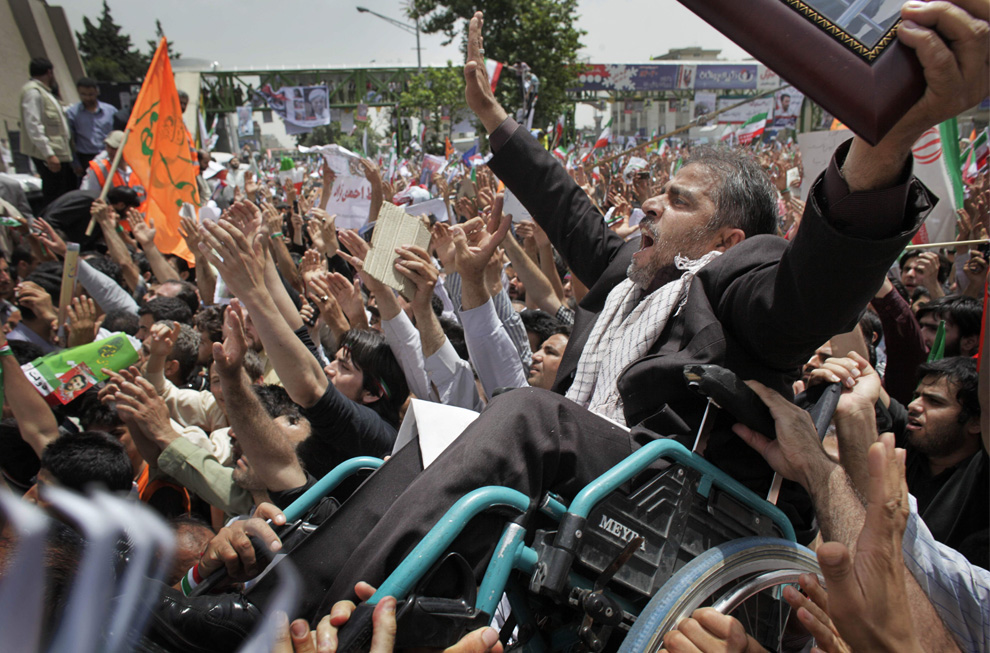
A wheelchair-bound supporter of Iranian President Mahmoud Ahmadinejad is lifted above the crowd at his final election campaign rally, on Azadi street in western Tehran, Iran, Wednesday, June 10, 2009. (AP Photo/Ben Curtis)
I mean, wow.
But something that struck me was the fact that several of the pictures of Mousavi supporters show crowds that are entirely or overwhelmingly composed of women. Look:

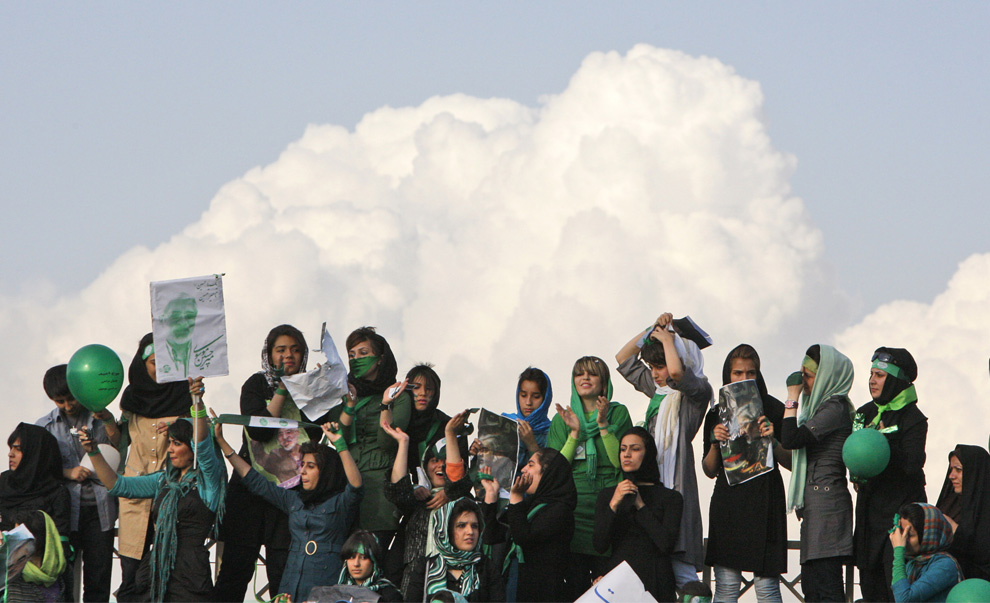
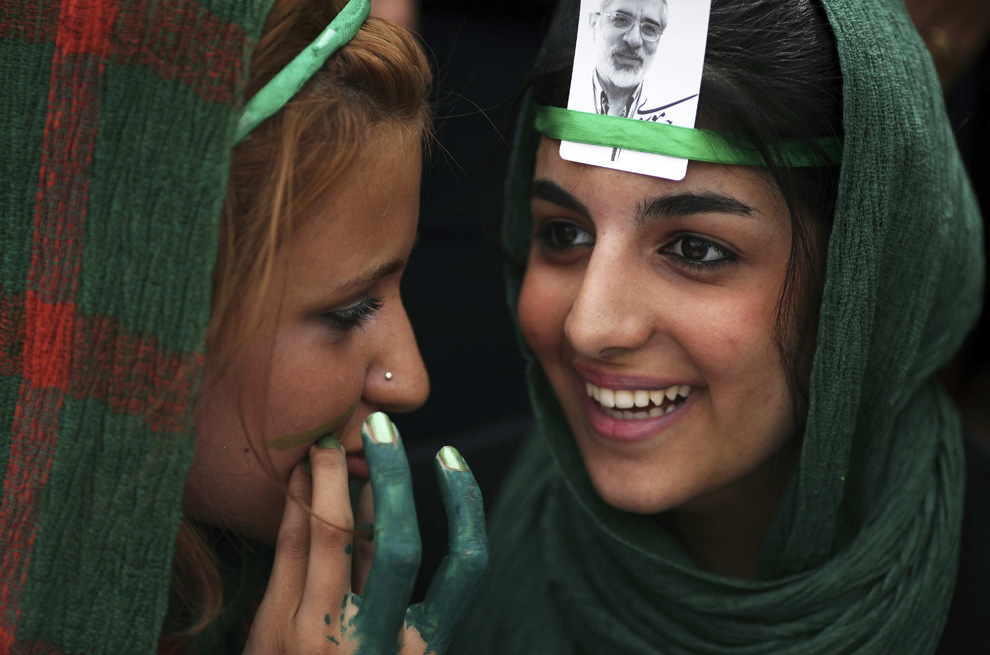
There are more. (Really, check the whole thing out, it's gorgeous.) Especially in the context of Anna's discussion of gender in the Lebanese elections at Feministing, I find this interesting. It may be that conservative women are simply less likely to attend rallies (where are all the male reformists, though? Are they not as pretty or something?) Anna:
First of all, speaking of chadors, from the Globe again:
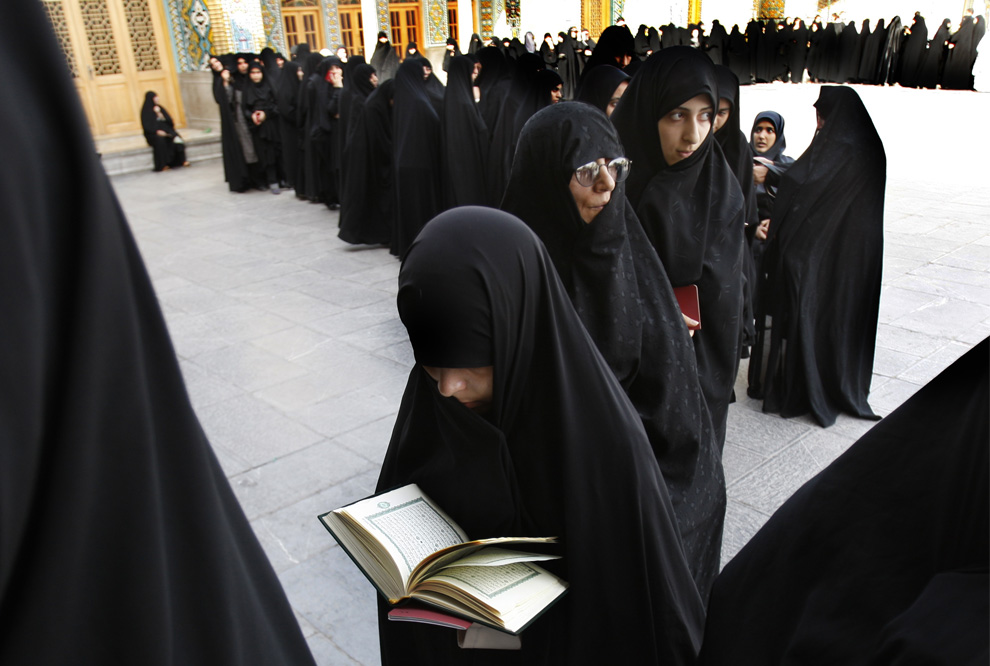
An Iranian women recites the holy Quran as she stands in line to cast her vote at the Masoumeh shrine in Qom, Iran on Friday, June 12, 2009. (AP Photo/Kamran Jebreili)
What an incredible image. I wonder why there are only women there; are polling stations gender-segregated? Do conservatives self-segregate? Just (unlikely) chance?
Regardless of the actual explanation, I'm quite sure it will never be explained or even examined by the Western press. I'm ashamed to admit that I had committed the pathetic fallacy that Anna implicitly pointed out of viewing Arab electoral politics only one way (in Lebanon by sect, in Iran by class/political orientation) and viewing Arab gender politics entirely separately. No one here is interested in the gender dynamics of these elections, because we're only concerned with the elections as they relate to us.
The dirty secret of Lebanese sectarianism is that it was revolutionized, fostered and empowered by the Western Great Powers (primarily Britain and France) starting in the mid-nineteenth century. (See Usama Makdisi's fabulous book The Culture of Sectarianism, which everyone should read before talking about Lebanon.) Various Western interests took religious communities as their own special protegés, partly as a way to get an economic foothold and partly as civilizing projects. The legacy of this dynamic is that we view shifts in the power distributions among various sects as signs of our own power and of the public's opinion of us. This is part of why we're so interested in Lebanese politics (that and all the civil war, and the wars with Israel).
Similarly, in Iran, we are not truly interested in the status of women--we occasionally make concerned noises, but usually it's a prop for a larger dislike of our regional enemy, a way of othering Iranians. I'm not saying women have it peachy keen; they don't. I'm saying that most American political concern for them is disingenuous, at best half-hearted. We're interested in elections and reformers for our own benefit.
And to an extent, that makes perfect sense: nations are self-interested. But the downfall of that view is that it really limits our ability to analyze events like these because we only have one lens. It didn't occur to me to wonder what the gender breakdowns in either election were, or to consider gender as a factor. (And I don't have a self-interest excuse: I'm a person, not a nation, and I study the Middle East.) Now that Anna--and these pictures--have forced me to think about it, it makes lots of sense that young women would be inclined toward the reformers' camp. They're educated, they have few prospects (Iran has a very educated and very unemployed population), and they want more options than Iranian women have had since 1979.
Ultimately, I don't have a lot to say about women in Iran, because I don't know much. I try not to speculate too much about subjects close to my specialty--coming out a doofus close to home is much worse than considering subjects that aren't important to me. But I'm glad that this blind spot has become visible to me. Now I can fix it.
In closing, may I say that Iran is walloping us when it comes to attractive polling places.
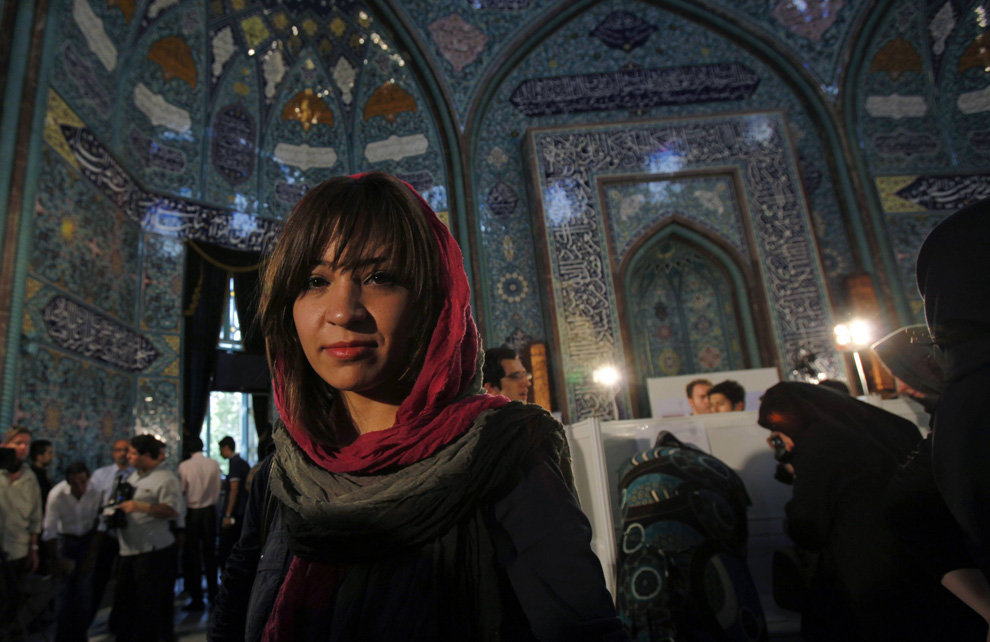
An woman arrives at a polling station during the Iranian presidential election in Tehran June 12, 2009. (REUTERS/Ahmed Jadallah)
A wheelchair-bound supporter of Iranian President Mahmoud Ahmadinejad is lifted above the crowd at his final election campaign rally, on Azadi street in western Tehran, Iran, Wednesday, June 10, 2009. (AP Photo/Ben Curtis)
I mean, wow.
But something that struck me was the fact that several of the pictures of Mousavi supporters show crowds that are entirely or overwhelmingly composed of women. Look:
There are more. (Really, check the whole thing out, it's gorgeous.) Especially in the context of Anna's discussion of gender in the Lebanese elections at Feministing, I find this interesting. It may be that conservative women are simply less likely to attend rallies (where are all the male reformists, though? Are they not as pretty or something?) Anna:
I would like to think that the FPM’s nauseating “Sois Belle et Vote” (“Be beautiful and vote”) posters had something to do with [the opposition's loss].
[...]
Because of its sectarian political system (and corruption, and personality cults, and nepotism, and foreign interference, and its electoral law, and and and), Lebanese politics are at the extreme end of “unresponsive,” and very few politicians or parties boast nuanced, concrete platforms. But it’s one thing to not respond to female voters; it’s another to insult them.
This is in sharp contrast to what appears to be happening in Iran, if we are to believe NPR, the BBC, the WSJ, Reuters, The Times, and a number of other news outlets who are focusing on the power of politicians’ wives and the preferences of women voters in tomorrow’s elections. People here in Lebanon whose political leanings tend away from the Hizballah/Aoun opposition often refer to Hizballah’s Iranian sponsorship and express fear that Lebanon’s free, liberated (read: tank tops, bikinis, bank loans available for plastic surgery) women will find themselves swathed in chadors should the other side ever claim a political victory.
In both countries, whatever they are wearing and whatever they look like, women are highly educated (in Iran they are majority of university students) and have brains of their own in perfect working order. The way these consecutive election campaigns were/are being conducted – with Lebanese politicians ignoring women’s demands in favor of appealing to their presumed vanity, and Iranian politicians at least making an effort to promise things like cabinet posts to women – says a lot more about how women are viewed as citizens than their dress codes.
First of all, speaking of chadors, from the Globe again:
An Iranian women recites the holy Quran as she stands in line to cast her vote at the Masoumeh shrine in Qom, Iran on Friday, June 12, 2009. (AP Photo/Kamran Jebreili)
What an incredible image. I wonder why there are only women there; are polling stations gender-segregated? Do conservatives self-segregate? Just (unlikely) chance?
Regardless of the actual explanation, I'm quite sure it will never be explained or even examined by the Western press. I'm ashamed to admit that I had committed the pathetic fallacy that Anna implicitly pointed out of viewing Arab electoral politics only one way (in Lebanon by sect, in Iran by class/political orientation) and viewing Arab gender politics entirely separately. No one here is interested in the gender dynamics of these elections, because we're only concerned with the elections as they relate to us.
The dirty secret of Lebanese sectarianism is that it was revolutionized, fostered and empowered by the Western Great Powers (primarily Britain and France) starting in the mid-nineteenth century. (See Usama Makdisi's fabulous book The Culture of Sectarianism, which everyone should read before talking about Lebanon.) Various Western interests took religious communities as their own special protegés, partly as a way to get an economic foothold and partly as civilizing projects. The legacy of this dynamic is that we view shifts in the power distributions among various sects as signs of our own power and of the public's opinion of us. This is part of why we're so interested in Lebanese politics (that and all the civil war, and the wars with Israel).
Similarly, in Iran, we are not truly interested in the status of women--we occasionally make concerned noises, but usually it's a prop for a larger dislike of our regional enemy, a way of othering Iranians. I'm not saying women have it peachy keen; they don't. I'm saying that most American political concern for them is disingenuous, at best half-hearted. We're interested in elections and reformers for our own benefit.
And to an extent, that makes perfect sense: nations are self-interested. But the downfall of that view is that it really limits our ability to analyze events like these because we only have one lens. It didn't occur to me to wonder what the gender breakdowns in either election were, or to consider gender as a factor. (And I don't have a self-interest excuse: I'm a person, not a nation, and I study the Middle East.) Now that Anna--and these pictures--have forced me to think about it, it makes lots of sense that young women would be inclined toward the reformers' camp. They're educated, they have few prospects (Iran has a very educated and very unemployed population), and they want more options than Iranian women have had since 1979.
Ultimately, I don't have a lot to say about women in Iran, because I don't know much. I try not to speculate too much about subjects close to my specialty--coming out a doofus close to home is much worse than considering subjects that aren't important to me. But I'm glad that this blind spot has become visible to me. Now I can fix it.
In closing, may I say that Iran is walloping us when it comes to attractive polling places.
An woman arrives at a polling station during the Iranian presidential election in Tehran June 12, 2009. (REUTERS/Ahmed Jadallah)
Saturday, June 13, 2009
God is great
Never in my life did I think I would see Andrew Sullivan write Allahu Akbar.
Snark aside, the post itself is a good thought (if delivered in typically epic language), and one I had as well--see the title of my previous one. Twitter and other new media have been essential to the opposition in Iran and to the publication of their efforts. Sullivan's comment that "you cannot stop people any longer" because they can get around the roadblocks with such technologies reminded me, oddly enough, of Russian History class back in high school. We discussed the roles of new transportation and communication technologies in making the October revolution possible.
I wonder if most revolutions depend on some kind of similar communication or transportation asymmetry. The 1979 Iranian Revolution was hugely dependent on cassette tapes: these were used to illicitly distribute Khameini's sermons to the public. The moment of triumph was the moment that the revolutionaries got control of the state television station and broadcast Khameini's arrival in Tehran, something the Shah had blacked out.
I mean actual revolutions, mind you, not coups: for a good coup all you need is some well-placed friends, an authoritarian system, and a little luck. Communications hardly matter. In actual revolutions, though, people need to be able to talk to each other. They need to feel that they're not alone, they need to plan and organize. Whoever's in power will always try to stop this, and usually an authoritarian state is pretty good at that. So most of the time, you need an asymmetry for this to happen at all, no? You need places where the government can't reach. Like illegal cassete tapes, or Twitter, or tunnels.
Snark aside, the post itself is a good thought (if delivered in typically epic language), and one I had as well--see the title of my previous one. Twitter and other new media have been essential to the opposition in Iran and to the publication of their efforts. Sullivan's comment that "you cannot stop people any longer" because they can get around the roadblocks with such technologies reminded me, oddly enough, of Russian History class back in high school. We discussed the roles of new transportation and communication technologies in making the October revolution possible.
I wonder if most revolutions depend on some kind of similar communication or transportation asymmetry. The 1979 Iranian Revolution was hugely dependent on cassette tapes: these were used to illicitly distribute Khameini's sermons to the public. The moment of triumph was the moment that the revolutionaries got control of the state television station and broadcast Khameini's arrival in Tehran, something the Shah had blacked out.
I mean actual revolutions, mind you, not coups: for a good coup all you need is some well-placed friends, an authoritarian system, and a little luck. Communications hardly matter. In actual revolutions, though, people need to be able to talk to each other. They need to feel that they're not alone, they need to plan and organize. Whoever's in power will always try to stop this, and usually an authoritarian state is pretty good at that. So most of the time, you need an asymmetry for this to happen at all, no? You need places where the government can't reach. Like illegal cassete tapes, or Twitter, or tunnels.
The revolution will be socially networked
The Iranian election and subsequent protests have been fascinating and heartwrenching. I wish I knew more about Iran, but I really only know the basics--my focus has been on Levantine Arab countries.
At any rate, what's going on right now is history in the making. (I wonder how many theses will be written on these clashes--even if the protesters are unsuccessful--a few years from now. Get me out of academia.) Basically, it seemed like the reformist challenger, Mousavi, was probably going to win. Supporters had been in the streets for days. Then the initial election results were confusing, muddied, and then started to just look funny with a ridiculous margin for Ahmedinejad. At this point, it's pretty clear the election was stolen. It seems the regime has abandoned appearances altogether and is just going for broke. Mousavi is under house arrest, people are screaming and marching and bleeding in the streets. I don't know where this is going to go.
A "victory for the Iranian people," Ahmedinejad has called it. In a sense, he's right: the regime would have been far better off allowing Mousavi to win and curry favor with the U.S. and others while the nuclear project plugged away and the theocracy got some street cred. The ridiculously ham-handed way they've done this has made the fiction impossible. If they crack down hard enough and people give up, then they will have won a huge authoritarian victory, as Digby describes here. If they fail to do so...who knows? The whole thing would be cracked wide open. So whether Ahmedinejad's coronation is a victory for the people or not, it's definitely not good for Ayatollah Khameini. (This begs the question of what on earth Khameini thinks he's doing at the moment, other than panicking--this is in large part his doing--but this is the sort of thing those theses I mentioned will be dealing with. The data's not there now and may not be for years.)
So far he has been congratulated by the Muslim Brotherhood, Hamas, Hizbullah (if I remember correctly), and...Syria. I don't know if Syria anticipated being out in front alone like that; I wonder if they'll regret it. I have no idea how this will affect Iran's regional clout or the way Arabs view the country. I simply don't know enough about this topic to speculate in any remotely worthwhile manner.
The regime seems to have blocked cellphones and many websites, but Twitter and Youtube keep updating with reports and footage of protests, police brutality, statements by both sides, and so on. Here are some resources:
The NYTimes Lede Blog
Andrew Sullivan
niacINsight
Nico Pitney at HuffPo
Juan Cole with Top Pieces of Evidence the election was stolen.
At any rate, what's going on right now is history in the making. (I wonder how many theses will be written on these clashes--even if the protesters are unsuccessful--a few years from now. Get me out of academia.) Basically, it seemed like the reformist challenger, Mousavi, was probably going to win. Supporters had been in the streets for days. Then the initial election results were confusing, muddied, and then started to just look funny with a ridiculous margin for Ahmedinejad. At this point, it's pretty clear the election was stolen. It seems the regime has abandoned appearances altogether and is just going for broke. Mousavi is under house arrest, people are screaming and marching and bleeding in the streets. I don't know where this is going to go.
A "victory for the Iranian people," Ahmedinejad has called it. In a sense, he's right: the regime would have been far better off allowing Mousavi to win and curry favor with the U.S. and others while the nuclear project plugged away and the theocracy got some street cred. The ridiculously ham-handed way they've done this has made the fiction impossible. If they crack down hard enough and people give up, then they will have won a huge authoritarian victory, as Digby describes here. If they fail to do so...who knows? The whole thing would be cracked wide open. So whether Ahmedinejad's coronation is a victory for the people or not, it's definitely not good for Ayatollah Khameini. (This begs the question of what on earth Khameini thinks he's doing at the moment, other than panicking--this is in large part his doing--but this is the sort of thing those theses I mentioned will be dealing with. The data's not there now and may not be for years.)
So far he has been congratulated by the Muslim Brotherhood, Hamas, Hizbullah (if I remember correctly), and...Syria. I don't know if Syria anticipated being out in front alone like that; I wonder if they'll regret it. I have no idea how this will affect Iran's regional clout or the way Arabs view the country. I simply don't know enough about this topic to speculate in any remotely worthwhile manner.
The regime seems to have blocked cellphones and many websites, but Twitter and Youtube keep updating with reports and footage of protests, police brutality, statements by both sides, and so on. Here are some resources:
The NYTimes Lede Blog
Andrew Sullivan
niacINsight
Nico Pitney at HuffPo
Juan Cole with Top Pieces of Evidence the election was stolen.
Wednesday, June 10, 2009
Capitalizing on the closing
To invoke a blogly cliché: what Digby said.
How Tiller's Death and Office Closing can Help Propel Pro-Life Movement, Derail Sotomayor and Overturn Roe. Four Key Senators will be Targeted to Vote Against Sotomayor; Catholic Bishops will Play a Role to Defeat Sotomayor
Press conference 1 PM, Thursday, to announce details how Pro-life groups can derail Sotomayor, and root out hypocrisy in pro-life ranks.
Also: Emergency Pro-life leadership training to be held in DC, June 12-14, with Randall Terry, Dr. Alan Keyes, Norma McCorvey, and Fr. Norman Weslin. Pro-abortion activists threaten to disrupt meeting.
Sunday, May 3, 2009
Vigilantism in our politics, or: Mr. Smith suiting up?
It appears that ordinary citizens are declaring themselves superheroes--you know, masked vigilantes, citizen crimefighters, protectors of the innocent--in several American cities. Highest-profile is Shadow Hare from Cincinnati.
The linked article makes lots of fun of everyone involved, and I understand perfectly well why (not to mention it's from the UK Daily Mail). But I can't bring myself to just laugh outright. Maybe I've spent too much time with alternative comic books that investigate what superheroes signify, and with novels about comic books and superheroes, to take them unseriously. I've read far more in the metaliterature about superheroes (Watchmen, Kavalier & Clay, even Sandman to a degree) than I ever have in the actual superhero canon, and so when I think superheroes I really don't think flat (yet muscular!) characters in silly suits with unlikely adversaries and bad onomatopoeia for sound effects. I immediately think about mythology, cultural signifiers, narratives of good and evil, and perceptions of "the times we live in."
Along with that goes a certain affection for the notion of people who just decide "screw it, I'm dressing up and going out there." I'm not saying that such people, fictional or otherwise, are the sanest or best-adjusted; nor am I saying there is nothing laughable about them. But they do mean well in a much purer and easier sense, I think, than many other people who otherwise are similar. (Certainly they do in fictional cases.)
At any rate, via the video in the article it seems many of these people hang out at The World Superhero Registry, which has some rather forbidding language on its front page:
This does make one worry for their good intentions. (This is, of course, one of the eternal superhero dilemmas: don't we have laws for a reason? How can you be sure that your forces for good, once unleashed, will stay good? And what if there are disagreements about the good? But I digress.) I have no idea whether my reproducing content from the website would count as the sort of thing for which they require permission, as I am not a member of the press, but I'll avoid direct quotes.
I am fascinated by the Registry. There are three immediate requirements: costume (signifies dedication), heroic deeds (above and beyond your average concerned citizen), and motivation (personal, uncompensated, and spontaneous). The website has things you'd probably consider essential: tutorials, a forum, a map of superheroes around the world, and a place to request assistance. But there are also book and movie reviews, a photo gallery of self-made "gadgets", a support forum, a press kit, and a philosophy section. It is, in short, an online community not unlike special-interest websites that have been started before; it is actually eerily reminiscent of Glenn Beck's 9/12 project.
The similarity is no accident: I think there are some broad connections to be made between our politics and superhero fetishism and/or vigilantism (the two overlap but are not identical).
Firstly, I think the level of superhero activity--real and imagined--in this country at a given time is probably rather analogous to "right track/wrong track" polling: the U.S. is in a bit of a ditch at the moment and people feel the need to do something about it. Happily, not everybody expresses this impulse in the manner of Timothy McVeigh. Sure enough, the superhero map shows the highest concentration of superheroes in North America (by which I mean almost exclusively the U.S.), followed by South America, perhaps one guy in Finland, and a few in the UK. (Some of these people are clearly funning, but shhh. Some of them definitely are not, particularly in the U.S.)
Superhero mythology lends itself particularly well to clear-cut battles between good and evil (or at least the desire for such in the face of more difficult troubles), and particularly in the case of the Batman/Gotham storyline can be seen to be reflective of a notion of a tide of societal evils, venality and disintegration battering at the weakening bastions of order, justice, and virtue. I find it interesting that as far as I can tell, The Registry's superheroes are not interested in fighting terror--they want to improve the lives of the people around them. They want to improve their neighborhoods and (of course) themselves. The struggle here is not abroad, not Us (whoever We are) against The World, but Us against Ourselves.
One of the other major tropes of superheroics is, of course, transformation. Whether there is a paramount transformative moment (Peter Parker being bitten by the spider; the creation of Dr. Manhattan) or an everyday transformation (Bruce Wayne into Batman), or even a more essential transformation through which one discovers one's true nature as a mutant (X-men) or an alien (Superman), at some point the hero crosses a line from ordinary citizen to extraordinary activist. We are currently in a moment of intense economic upheaval; more than that, we are undergoing a profound national political unmooring in terms of conventional policy wisdom as well as our national self-definition on some key issues (torture, a social safety net, gay marriage, legalized marijuana). The increasing chasm between conservatives' and their opponents' views of what is currently happening in this country and what it may mean illustrates how much we are in free fall. We have found ourselves at what feels like an inflection point, and it seems necessary to redefine or at least investigate what it means to be an American as well as what it means to be a citizen of a democracy that has gotten so big, so delocalized, and so distant from its government. I give you Jim Manzi:
On its face, this passage is about waterboarding and about torture, but it is also very much about American notions of citizenship and representative government. Notice the distinction so easily and, it seems, unthinkingly drawn between a Republic, which makes demands on its citizens, and an imperial city (no capitalizations), which cossets its residents. In that contrast alone are notions of environment, borders, locality, global standing, and the relationship between a state and its constituents. These are the sorts of questions we are grappling with.
Many of the Registered Superheroes may have suffered their own economic dislocation. Some of them may be social conservatives who think the entire country is on the brink of sliding into the political, economic, and cultural sea. Some of them may be people who have been dissatisfied for a long time and have been hoped and changed and grassrootsed enough to try to go on and do something about it. Indeed, the relationship between ordinary and extraordinary persons and their ordinary and extraordinary acts is an essential one in American politics: activists try to convince people (in oddly Catholic fashion) that they, the ordinary, by good works can be transformed into the extraordinary, while politicians allow them a Protestant claim of grace newly discovered (did I mention that we are the ones we've been waiting for?). Watchmen vs. X-men, one might say. Similarly, American exceptionalism and certain forms of cultural nationalism on the right exult in the sheer ordinariness of certain tropes as signifiers of an exceptional nature--it is through ordinariness, and its inherent virtue, that we are transformed. Some of our most beloved political bedtime stories, such as Mr. Smith's much-vaunted trip to Washington, can be easily seen as a sort of whitewashed form of vigilantism in which everyone is a winner.
Despite all of this complicated hot air, some of these superheroes are definitely 11-year-old boys. Not everyone thinks in these terms, nor should they (if you think the economy is bad now, hoo boy do I have a doomsday scenario for you). But I do believe in zeitgeist and in discourses, and these currents are in the air.
What I want to know is, have phenomena like this arisen at every moment of national freefall? Is this happening now because a national movement like the Civil Rights movement or the anti-war movement of the 1960s and '70s is so deeply absent? Did this work remotely similarly before the internet, and if not, how essential is the reinforcing presence of colleagues in crimefighting? How analogous is this to other, more sinister forms of vigilantism? How does it relate to acts of domestic terrorism like the uber-conservative attacks on liberal churches and groups we saw a few months ago? Are these different responses to the same broad stimuli (with different triggers, clearly)? Is the difference in degree, kind, or both? What's the explanation for the apparent concentration of registered avengers in the eastern half of the country (in an unexpected twist, they are evenly distributed between North and South)? Finally, I think this could make a brilliant case study for some of the conservative critiques of the delocalizing, isolating, and concentrating effects of communications technology on culture (such as can be found at Front Porch Republic). What can I say, I love giving out free tips.
On a less political note (I can't help myself): I'm fascinated that the press's gentle mocking of these gentlefolk seems to center around their lack of physical impressiveness. I don't think even those commenting on the superheroes realize that their criticisms are precisely based in the superhero mythology they find so ludicrous. One would think that in this age of technological advancement we would find it less necessary to have someone's moral strength be so concretely represented in his or her physicality, but I suppose our culture is still plenty body-obsessed--perhaps particularly at a moment of disorientation and dislocation. (Plus, they don't quite have the gadget gallery up to Stephen Hawking's level.)
The linked article makes lots of fun of everyone involved, and I understand perfectly well why (not to mention it's from the UK Daily Mail). But I can't bring myself to just laugh outright. Maybe I've spent too much time with alternative comic books that investigate what superheroes signify, and with novels about comic books and superheroes, to take them unseriously. I've read far more in the metaliterature about superheroes (Watchmen, Kavalier & Clay, even Sandman to a degree) than I ever have in the actual superhero canon, and so when I think superheroes I really don't think flat (yet muscular!) characters in silly suits with unlikely adversaries and bad onomatopoeia for sound effects. I immediately think about mythology, cultural signifiers, narratives of good and evil, and perceptions of "the times we live in."
Along with that goes a certain affection for the notion of people who just decide "screw it, I'm dressing up and going out there." I'm not saying that such people, fictional or otherwise, are the sanest or best-adjusted; nor am I saying there is nothing laughable about them. But they do mean well in a much purer and easier sense, I think, than many other people who otherwise are similar. (Certainly they do in fictional cases.)
At any rate, via the video in the article it seems many of these people hang out at The World Superhero Registry, which has some rather forbidding language on its front page:
This website deals with the actual incorporation of the superhero archetype into daily life. As a consequence of the complex and ever-changing nature of the legal system and the diverse and unusual activities that may be involved in such alternative lifestyles, some of the activities described herein may be in conflict with local laws in some areas. None of the creators of this web page specifically condone any of the described activities or the possession of any of the equipment related to those activities. We are not legal experts and lack the expertise and resources to research the legality of any of the practices of our members, or visitors.
This does make one worry for their good intentions. (This is, of course, one of the eternal superhero dilemmas: don't we have laws for a reason? How can you be sure that your forces for good, once unleashed, will stay good? And what if there are disagreements about the good? But I digress.) I have no idea whether my reproducing content from the website would count as the sort of thing for which they require permission, as I am not a member of the press, but I'll avoid direct quotes.
I am fascinated by the Registry. There are three immediate requirements: costume (signifies dedication), heroic deeds (above and beyond your average concerned citizen), and motivation (personal, uncompensated, and spontaneous). The website has things you'd probably consider essential: tutorials, a forum, a map of superheroes around the world, and a place to request assistance. But there are also book and movie reviews, a photo gallery of self-made "gadgets", a support forum, a press kit, and a philosophy section. It is, in short, an online community not unlike special-interest websites that have been started before; it is actually eerily reminiscent of Glenn Beck's 9/12 project.
The similarity is no accident: I think there are some broad connections to be made between our politics and superhero fetishism and/or vigilantism (the two overlap but are not identical).
Firstly, I think the level of superhero activity--real and imagined--in this country at a given time is probably rather analogous to "right track/wrong track" polling: the U.S. is in a bit of a ditch at the moment and people feel the need to do something about it. Happily, not everybody expresses this impulse in the manner of Timothy McVeigh. Sure enough, the superhero map shows the highest concentration of superheroes in North America (by which I mean almost exclusively the U.S.), followed by South America, perhaps one guy in Finland, and a few in the UK. (Some of these people are clearly funning, but shhh. Some of them definitely are not, particularly in the U.S.)
Superhero mythology lends itself particularly well to clear-cut battles between good and evil (or at least the desire for such in the face of more difficult troubles), and particularly in the case of the Batman/Gotham storyline can be seen to be reflective of a notion of a tide of societal evils, venality and disintegration battering at the weakening bastions of order, justice, and virtue. I find it interesting that as far as I can tell, The Registry's superheroes are not interested in fighting terror--they want to improve the lives of the people around them. They want to improve their neighborhoods and (of course) themselves. The struggle here is not abroad, not Us (whoever We are) against The World, but Us against Ourselves.
One of the other major tropes of superheroics is, of course, transformation. Whether there is a paramount transformative moment (Peter Parker being bitten by the spider; the creation of Dr. Manhattan) or an everyday transformation (Bruce Wayne into Batman), or even a more essential transformation through which one discovers one's true nature as a mutant (X-men) or an alien (Superman), at some point the hero crosses a line from ordinary citizen to extraordinary activist. We are currently in a moment of intense economic upheaval; more than that, we are undergoing a profound national political unmooring in terms of conventional policy wisdom as well as our national self-definition on some key issues (torture, a social safety net, gay marriage, legalized marijuana). The increasing chasm between conservatives' and their opponents' views of what is currently happening in this country and what it may mean illustrates how much we are in free fall. We have found ourselves at what feels like an inflection point, and it seems necessary to redefine or at least investigate what it means to be an American as well as what it means to be a citizen of a democracy that has gotten so big, so delocalized, and so distant from its government. I give you Jim Manzi:
Suppose we had a 9/11-level attack with 3,000 casualties per year every year. Each person reading this would face a probability of death from this source of about 0.001% each year. A Republic demands courage – not foolhardy and unsustainable “principle at all costs”, but reasoned courage – from its citizens. The American response should be to find some other solution to this problem if the casualty rate is unacceptable. To demand that the government “keep us safe” by doing things out of our sight that we have refused to do in much more serious situations so that we can avoid such a risk is weak and pathetic. It is the demand of spoiled children, or the cosseted residents of the imperial city. In the actual situation we face, to demand that our government waterboard detainees in dark cells is cowardice.
On its face, this passage is about waterboarding and about torture, but it is also very much about American notions of citizenship and representative government. Notice the distinction so easily and, it seems, unthinkingly drawn between a Republic, which makes demands on its citizens, and an imperial city (no capitalizations), which cossets its residents. In that contrast alone are notions of environment, borders, locality, global standing, and the relationship between a state and its constituents. These are the sorts of questions we are grappling with.
Many of the Registered Superheroes may have suffered their own economic dislocation. Some of them may be social conservatives who think the entire country is on the brink of sliding into the political, economic, and cultural sea. Some of them may be people who have been dissatisfied for a long time and have been hoped and changed and grassrootsed enough to try to go on and do something about it. Indeed, the relationship between ordinary and extraordinary persons and their ordinary and extraordinary acts is an essential one in American politics: activists try to convince people (in oddly Catholic fashion) that they, the ordinary, by good works can be transformed into the extraordinary, while politicians allow them a Protestant claim of grace newly discovered (did I mention that we are the ones we've been waiting for?). Watchmen vs. X-men, one might say. Similarly, American exceptionalism and certain forms of cultural nationalism on the right exult in the sheer ordinariness of certain tropes as signifiers of an exceptional nature--it is through ordinariness, and its inherent virtue, that we are transformed. Some of our most beloved political bedtime stories, such as Mr. Smith's much-vaunted trip to Washington, can be easily seen as a sort of whitewashed form of vigilantism in which everyone is a winner.
Despite all of this complicated hot air, some of these superheroes are definitely 11-year-old boys. Not everyone thinks in these terms, nor should they (if you think the economy is bad now, hoo boy do I have a doomsday scenario for you). But I do believe in zeitgeist and in discourses, and these currents are in the air.
What I want to know is, have phenomena like this arisen at every moment of national freefall? Is this happening now because a national movement like the Civil Rights movement or the anti-war movement of the 1960s and '70s is so deeply absent? Did this work remotely similarly before the internet, and if not, how essential is the reinforcing presence of colleagues in crimefighting? How analogous is this to other, more sinister forms of vigilantism? How does it relate to acts of domestic terrorism like the uber-conservative attacks on liberal churches and groups we saw a few months ago? Are these different responses to the same broad stimuli (with different triggers, clearly)? Is the difference in degree, kind, or both? What's the explanation for the apparent concentration of registered avengers in the eastern half of the country (in an unexpected twist, they are evenly distributed between North and South)? Finally, I think this could make a brilliant case study for some of the conservative critiques of the delocalizing, isolating, and concentrating effects of communications technology on culture (such as can be found at Front Porch Republic). What can I say, I love giving out free tips.
On a less political note (I can't help myself): I'm fascinated that the press's gentle mocking of these gentlefolk seems to center around their lack of physical impressiveness. I don't think even those commenting on the superheroes realize that their criticisms are precisely based in the superhero mythology they find so ludicrous. One would think that in this age of technological advancement we would find it less necessary to have someone's moral strength be so concretely represented in his or her physicality, but I suppose our culture is still plenty body-obsessed--perhaps particularly at a moment of disorientation and dislocation. (Plus, they don't quite have the gadget gallery up to Stephen Hawking's level.)
Sunday, March 1, 2009
An interesting snippet
For those of us interested in political rights and institutions, anyway. David Schraub discusses Jews' security in the U.S. over at Alas, A Blog.
There is a difference between a legal right and a legislative privilege, and it isn’t just that the former is more difficult to dislodge. I’ve already written about why I think rights are important beyond the technical protections they do and do not provide. There is considerable expressive power in being seen as a rights-holder. A person who is protected from unequal treatment merely because they currently hold the favor of the sovereign and her sword exists on a qualitatively different plane from the person whose protection stems from the fact that society — as per the strong moral norms expressed through the language of rights — considers such discrimination to be a grave normative wrong.
[...]
The fact that rights often are a formalist facade does not, to my mind, mean they always are, or that they are meaningless. I think that possessing rights is a powerful social signal of full inclusion into the community. A protection by right is one that is normalized, a protection by special legislation is exceptional. I would much prefer to be in a position where I am protected because it is seen as wrong to hurt me, than to be protected simply because those who wish to hurt me are (currently) in no position to do so. The cynics would tell you that the former case does not exist. I refuse to believe that is true.
Subscribe to:
Posts (Atom)


 Posts
Posts

